
Understanding Engineered Hardwood Floors Installation: The Basics
Let’s face itchanging your home with beautiful new flooring is exciting, but can also feel a bit overwhelming. I’m here to walk you through the essentials of engineered hardwood floors installation with straightforward advice that’ll have you feeling confident about your project.
Engineered hardwood gives you the stunning look of real wood with some practical advantages that homeowners love. Unlike solid hardwood, engineered products feature a genuine wood veneer bonded to several layers of high-quality plywood or fiberboard. This clever design makes them more resistant to the expansion and contraction that happens with humidity and temperature changesmeaning you can install them in places where solid hardwood would be a no-go, like basements or directly over concrete.
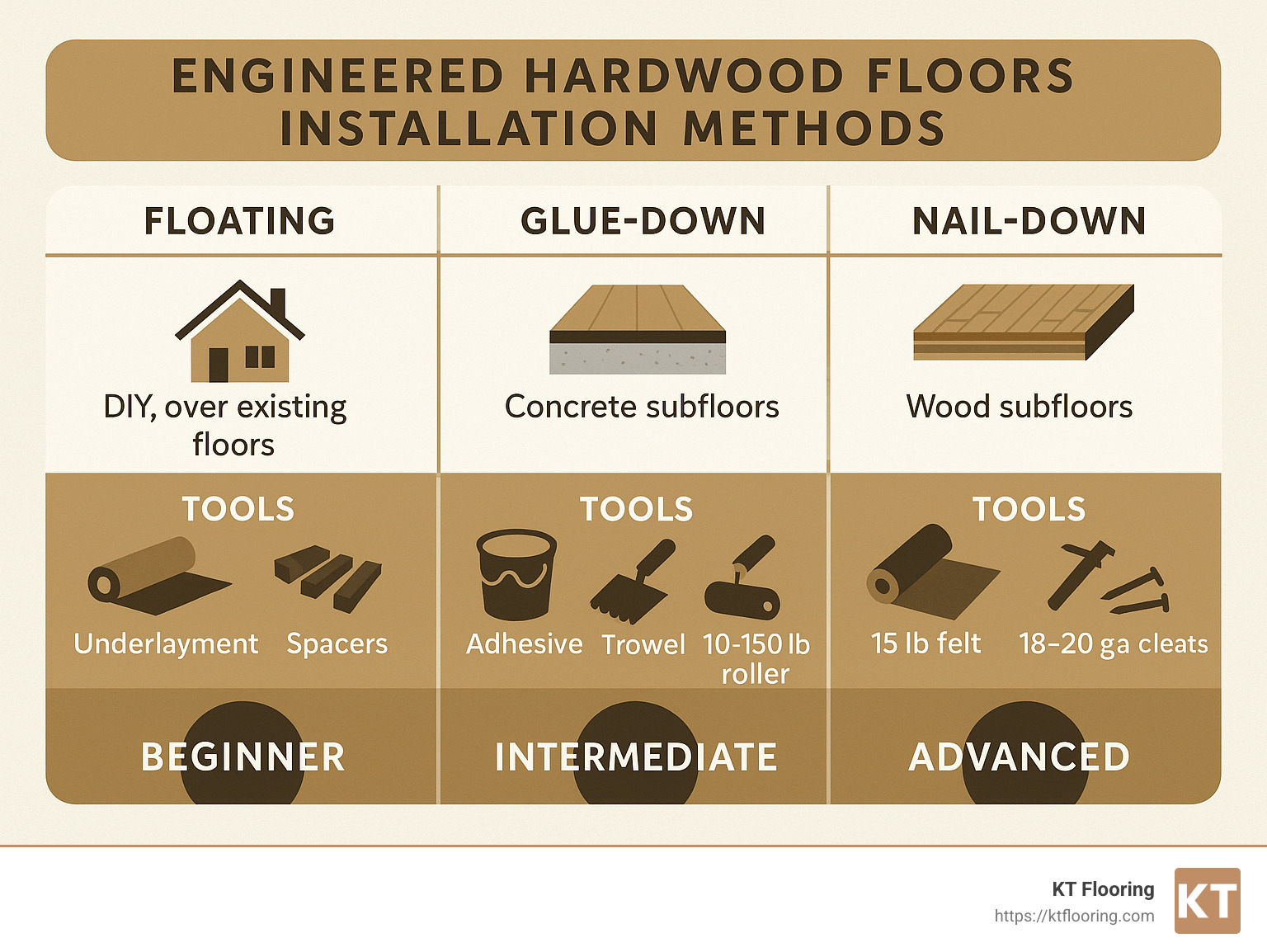
There are three main ways to install engineered hardwood, each with its own set of advantages:
| Installation Method | Best For | Difficulty Level | Tools Needed |
|---|---|---|---|
| Floating | DIY, above/below grade, over existing floors | Beginner | Underlayment, spacers, tapping block |
| Glue-Down | Concrete subfloors, high-traffic areas | Intermediate | Adhesive, trowel, 100-150 lb roller |
| Nail/Staple-Down | Wood subfloors, permanent installation | Advanced | Flooring nailer, 15 lb felt, 18-20 ga cleats |
The floating method is particularly DIY-friendlythe boards connect to each other rather than being attached to the subfloor. For concrete surfaces, the glue-down approach provides exceptional stability. If you’re working with a wood subfloor and want the most secure installation, the nail-down method might be your best bet, though it does require some specialized tools and know-how.
With some patience and attention to detail, you can absolutely master engineered hardwood floors installation within 30 days, even as a beginner. The secret to success lies in three key areas: understanding your subfloor conditions, selecting the right installation method for your situation, and carefully following the manufacturer’s guidelines for acclimation and expansion gaps.
I’ve seen countless homeowners tackle this project successfully, and the pride they feel walking across their newly installed floors is something special. At KT Flooring, we’ve guided homeowners throughout New Hampshire and Massachusetts through successful installations for decades, helping turn challenging flooring projects into beautiful, lasting investments.
Engineered Hardwood vs. Solid Hardwood – Know Your Material
When you’re about to start on an engineered hardwood floors installation project, understanding what sets it apart from solid hardwood is essential. This knowledge isn’t just academic – it will guide your decisions throughout the entire installation process.
Engineered hardwood has a clever “sandwich” construction. The top layer is genuine hardwood – the beautiful surface you’ll see and walk on daily. Beneath this veneer are multiple layers of high-quality plywood or high-density fiberboard (HDF) arranged in a cross-grain pattern. This smart design creates remarkable stability, allowing the floor to resist the natural expansion and contraction that occurs when humidity levels change.
| Feature | Engineered Hardwood | Solid Hardwood |
|---|---|---|
| Construction | Wood veneer over plywood/HDF layers | Single piece of solid wood |
| Thickness | 3/8″ to 3/4″ | 3/4″ typically |
| Stability in humidity | High resistance to warping | More susceptible to expansion/contraction |
| Installation locations | Above, on, or below grade | Above grade only |
| Refinishing potential | 1-7 times (depends on veneer thickness) | Multiple times (8-10+) |
| Average cost (internet data) | $4.50-$16 per sq ft | $5-$28 per sq ft |
| Radiant heat compatible | Yes (most products) | Limited |
“Engineered hardwood floors handle moisture and humidity changes better than solid hardwood,” as Jeff Hosking, a veteran flooring consultant, puts it. This resilience makes engineered flooring perfect for spaces where traditional hardwood might struggle – like basements or rooms with concrete subfloors.
Pay special attention to the veneer thickness when selecting your engineered hardwood. This seemingly small detail actually determines how many times you can sand and refinish your floor over its lifetime. Premium options with thicker wear layers (3/16″ or more) can be refinished multiple times, giving you decades of fresh looks. Budget-friendly options with thinner veneers (1/16″ or less) might only allow for one light sanding, if they can be refinished at all.
Why Choose Engineered for Your Project
Here in New England, engineered hardwood makes perfect sense for so many reasons. As we’ve seen throughout New Hampshire and Massachusetts, these floors offer practical benefits that solid hardwood simply can’t match.
Installation versatility tops the list of advantages. Unlike solid hardwood, which must be installed above grade, engineered products are happy above, on, or below grade level. That finished basement you’ve been dreaming about? Engineered hardwood makes it possible.
If you’ve ever experienced a New Hampshire winter, you’ll appreciate that most engineered hardwood is compatible with radiant heating systems. Imagine stepping onto warm, beautiful hardwood floors on those frosty January mornings! This feature alone convinces many of our Hudson and surrounding area customers.
The dimensional stability of engineered hardwood is remarkable. Its cross-layered construction stands strong against New England’s notorious seasonal humidity swings. While solid hardwood might develop gaps in winter and swell in summer, engineered floors maintain their good looks year-round.
Want those gorgeous wide planks that are so popular today? Engineered construction makes wider boards possible without the warping concerns that often plague solid hardwood of the same width. This gives you more design flexibility for creating your dream space.
Many homeowners are surprised to learn about the environmental benefits of engineered hardwood. Because only the top layer uses premium hardwood species, these floors often represent a more resource-efficient choice than solid hardwood.
After installing countless floors throughout southern New Hampshire and northeastern Massachusetts, we’ve seen engineered hardwood perform beautifully in diverse settings – from historic Nashua colonials to sleek modern apartments in downtown Manchester. Its versatility and resilience make it a smart choice for our region’s unique demands.
Pre-Installation Prep: Jobsite, Subfloor & Acclimation Essentials
Success with engineered hardwood floors installation starts long before you open your first box of flooring. Taking time to properly prepare might feel tedious, but I’ve seen countless beautiful floors fail simply because someone rushed through this critical phase.
Creating the Right Environment
Your new flooring needs to feel at home before it’s installed. Think of it as giving your hardwood a chance to get comfortable in its new environment:
Your home’s climate needs to be just right – keep your HVAC running steadily for at least a week before installation, maintaining temperatures between 60-75°F and relative humidity between 30-50%. This isn’t just a suggestion – it’s essential for preventing warping, buckling, and gaps down the road.
I always tell my clients to schedule their installation after other messy construction work is finished. There’s nothing worse than watching a painter accidentally drip on your beautiful new floors! A clean, calm environment makes for the best installation conditions.
Assessing and Preparing the Subfloor
Your subfloor is like the foundation of a house – if it’s not right, nothing above it will be either. Whether you have wood or concrete, proper assessment is non-negotiable.
For wood subfloors, start by checking that it’s clean, structurally sound, and most importantly, dry. Use a quality moisture meter to verify the moisture content is 12% or less. The subfloor should be within 4% of your flooring’s moisture content to prevent problems later. Check for flatness too – you’ll need it within 1/8″ in 10′ for a smooth installation.
Concrete subfloors require even more attention. They must be fully cured (at least 60 days old) and properly tested for moisture. Conduct a calcium chloride test (results should be under 3 lbs/1,000 sq.ft. in 24 hours) or relative humidity test (should be below 75%). If your readings exceed these levels, you’ll need a moisture barrier system before proceeding.
For either subfloor type, flatness is crucial – high or low spots can cause hollow sounds, creaking, or even damage to your new floor’s locking system. Take the time to fix any issues now – your future self will thank you!
If subfloor preparation feels overwhelming, KT Flooring offers comprehensive subfloor services throughout Southern New Hampshire and Northeast Massachusetts. Sometimes calling in professionals for this foundation work makes the difference between a good floor and a great one.
Acclimating Boards the Right Way
Acclimation isn’t just a fancy word flooring professionals use to sound important – it’s truly essential for the longevity of your floor.
Bring your flooring into the installation space and cross-stack the unopened cartons to allow air circulation around them. Let them sit for 48-72 hours (though always check your specific manufacturer’s guidelines, as some products have different requirements). This gives the wood time to adjust to your home’s unique climate conditions.
During acclimation, use your moisture meter to check both the subfloor and flooring until the difference is 4% or less. I remember one client who skipped this step during a humid summer week – by fall, their beautiful floor had developed unsightly gaps that could have been prevented with proper acclimation.
Setting Up the Workspace
Before you dive in, take time to set up properly:
Remove baseboards carefully if you plan to reuse them (a small investment in a pry bar and painter’s tool will save your walls and trim from damage). Gather your safety equipment – your knees, lungs, and eyes will appreciate protection during this process!
Have all your tools ready: tape measure, chalk line, carpenter’s square, pencil, utility knife, jamb saw, tapping block, pull bar, and installation-specific tools like floor nailers or adhesive trowels.
Don’t forget to calculate material needs with a proper waste allowance – add 5-7% for standard installations, or up to 15% for diagonal or herringbone patterns. There’s nothing worse than running short on the final row!
With thorough preparation complete, you’ll have set yourself up for a successful installation. The care you take during these preliminary steps directly translates to the beauty and durability of your finished floor. As we say at KT Flooring, “Measure twice, prepare thoroughly, install once.”
Engineered Hardwood Floors Installation Methods Explained
When it comes to engineered hardwood floors installation, you have three main methods to choose from. I’ve helped countless homeowners throughout New Hampshire and Massachusetts select the right approach for their specific needs and skill levels.
Each installation method has its own character, advantages, and learning curve. Let’s walk through your options so you can make the best choice for your home.
Method Overview
Think of installation methods like different recipes that all result in beautiful floors, but with slightly different techniques and tools.
The floating method connects planks to each other (not the subfloor) and is perfect for DIYers looking for a quicker installation. For a more permanent solution, glue-down creates that solid feel underfoot that many homeowners love, while nail-down offers that traditional hardwood installation approach for wood subfloors.
No matter which method you choose, remember the golden rule of hardwood installation: always leave expansion gaps of at least ½” around the perimeter. These gaps are your floor’s breathing room, allowing natural expansion and contraction with seasonal changes. I’ve seen beautiful installations ruined by skipping this critical step!
For comprehensive guidance, our Hardwood Flooring Installation Instructions provide manufacturer-specific details you’ll want to review before starting.
Step-by-Step Engineered Hardwood Floors Installation — Glue-Down
The glue-down method creates a floor with that solid, substantial feel that many of our New England customers prefer. It’s especially well-suited for concrete subfloors and high-traffic family spaces.
Start by snapping a chalk line parallel to your starting wall to ensure your first row stays perfectly straight. This guideline is your roadmap for the entire installation.
When working with adhesive, timing is everything. I always recommend working in smaller sections (about 2-3 rows wide) that you can complete within 30-45 minutes. Using a notched trowel (typically 3/16″), spread your urethane adhesive at a 45° angle for optimal coverage.
As you place your planks, maintain that critical expansion gap using spacers along the walls. Work methodically across the room, checking for straightness every few rows. One pro tip I share with all my clients: clean adhesive spills immediately with the manufacturer’s recommended cleaner. Dried adhesive can be nearly impossible to remove without damaging your beautiful new floor.
After installing several rows, roll the section with a 100-150 lb roller. This step ensures proper adhesive transfer and strong bonding. Your arms might be tired, but your floor will thank you with decades of stable performance.
Step-by-Step Engineered Hardwood Floors Installation — Nail/Staple-Down
For wood subfloors, the nail-down method provides that solid, traditional hardwood installation feel. It’s my go-to recommendation for many Hudson and Nashua area homes with plywood subfloors.
Begin by rolling out 15 lb felt paper underlayment across your subfloor, overlapping seams by 4-6 inches. This creates a moisture barrier and reduces potential squeaks.
The first couple of rows present a unique challenge since your flooring nailer can’t get close enough to the wall. For these rows, you’ll need to face-nail or glue boards in place. I always recommend pre-drilling to prevent splitting those beautiful boards you’ve invested in.
Once you have enough clearance, switch to blind-nailing through the tongue at a 45° angle. Maintain a consistent fastener schedule, placing 18-20 gauge cleats or staples 1-3″ from board ends and every 4-6″ along the length. This creates a secure hold while keeping fasteners hidden.
As you approach the opposite wall, you’ll again need to face-nail the final rows where the nailer won’t fit. Pre-drill, countersink, and later fill these holes with color-matched wood putty for a seamless finish.
Step-by-Step Engineered Hardwood Floors Installation — Floating
The floating method is the most DIY-friendly approach and has become increasingly popular among our first-time installer clients. It works beautifully over most existing subfloors, including vinyl, tile, or wood.
Start by laying your underlayment perpendicular to your planned flooring direction. For concrete subfloors, you’ll also need a vapor barrier. Unlike other underlayments, these should be butted together without overlapping, with seams taped for continuity.
Place spacers (minimum ¼”) along all walls to maintain that crucial expansion gap. Floating floors have a maximum recommended span of 40 feet in any direction—for larger rooms, you’ll need expansion breaks.
The installation technique varies slightly depending on whether you have click-lock or tongue-and-groove boards. Click-lock systems simply angle and snap together, while tongue-and-groove products require a thin bead of wood glue along the top of the groove. Use a tapping block (never hammer directly on the boards!) to protect edges while securing tight joints.
One trick I’ve found helpful is using painter’s tape across several boards every few rows to prevent separation while the glue sets. It’s an extra step that pays dividends in the finished product.
Floating floors demand stricter flatness tolerances (1/8″ in a 10′ radius) than other methods, so proper subfloor preparation is absolutely essential. For more detailed guidance on floating installations, visit our guide on how to Install Engineered Hardwood Floor.
Whether you’re tackling this project yourself or considering professional installation for your New Hampshire or Massachusetts home, understanding these methods helps you make informed decisions about your engineered hardwood floors installation. And remember, we’re always here to help if questions arise along the way!
Advanced Challenges & Pro Techniques
As you gain confidence with basic engineered hardwood floors installation, you’ll want to master some of the more challenging aspects that separate amateur from professional results.
Doorways and Transitions
Doorways present unique challenges during installation:
- Undercutting Door Casings: Use a scrap piece of flooring and underlayment as a guide to mark the correct height. Cut the casing with a jamb saw to allow the flooring to slide underneath for a clean finish.
- Doorway Transitions: When flooring meets different flooring types, install appropriate transition strips. For hardwood-to-hardwood transitions, T-moldings are typically used, while reducers help transition to lower surfaces like vinyl or carpet.
- Direction Changes: In open floor plans, maintaining consistent direction adds visual flow. If direction must change (like in an L-shaped room), use a spline to reverse direction.
Managing Long Runs
For large rooms or open floor plans, consider these professional techniques:
- Expansion Breaks: For floating floors exceeding 40 feet in any direction, incorporate T-moldings as expansion breaks to prevent buckling.
- Rack Planning: Pre-lay several rows without fastening to ensure pleasing color variation and stagger patterns. This “racking” technique helps avoid clusters of similar boards.
- Center-Out Installation: For very large rooms, some pros start from the center and work outward, which can minimize the visual impact of any slight walls that aren’t perfectly square.
Radiant Heat Considerations
When installing over radiant heat systems:
- Temperature Control: The system should be run at 2/3 capacity for at least 2 weeks prior to installation to further dry out the subfloor.
- Gradual Changes: After installation, temperature changes should be made gradually (maximum 5°F per day) to allow the wood to acclimate.
- External Thermostat: Use an external thermostat that measures floor temperature to prevent overheating, which can damage the flooring.
“Radiant-heat installations require gradual temperature changes and an outside thermostat to minimize wood moisture swings,” notes a technical installation guide.
Moisture Barriers on Concrete
For installations over concrete, proper moisture mitigation is critical:
- Vapor Barriers: For floating installations, use a 6-mil polyethylene sheet or underlayment with attached vapor barrier.
- Moisture-Mitigating Adhesives: For glue-down installations, consider adhesives with built-in moisture barriers that can protect against higher moisture levels.
- Two-Step Systems: In cases of high moisture readings, a two-step system with a separate moisture barrier and then adhesive may be necessary.
Avoiding Visible Patterns & Squeaks
The difference between amateur and professional installations often comes down to these details:
- Staggering Joints: End joints should be staggered a minimum of 6″ for strip flooring, 8-10″ for 3″ to 5″ plank, and 10″ for plank wider than 5″.
- Random Length Patterns: Avoid creating “H” or “stair-step” patterns by varying the length of boards at the beginning of each row.
- Squeaky Floor Prevention: For nail-down installations, ensure the subfloor is securely fastened to joists. For floating floors, some installers lightly dust the tongue and groove with talcum powder to reduce friction.
“End joints of boards should be staggered a minimum of 6″ for strip flooring, 8-10″ for 3″ to 5″ plank, and 10″ for plank wider than 5″ for better visual effects and structural stability,” advises a technical installation guide.
With these advanced techniques, your engineered hardwood installation will not only function properly but will have the refined appearance of professional craftsmanship.
Post-Install Cleanup, Inspection & Maintenance
The moment you lay that final plank of engineered hardwood floors installation feels triumphant, but your journey isn’t quite complete. The care you take in these finishing stages can make all the difference between a good floor and a great one that lasts for decades.
Immediate Post-Installation Care
Your new floor needs a little breathing room before it becomes the center of your home’s activity. For glue-down installations, give the adhesive a full 24 hours to properly cure before allowing regular foot traffic. The same waiting period applies if you’ve installed a floating floor with glued joints – patience here prevents future headaches.
Once the waiting period has passed, it’s time to remove all those spacers from around the perimeter. They’ve done their job creating expansion gaps, but now they need to go. If you used painter’s tape to hold boards together during installation, peel it away after about 8-10 hours – leaving it too long might affect the finish.
“The first cleaning is like your floor’s debut,” says Chris Talty of KT Flooring. “Treat it gently, like you’re introducing it to its new life in your home.” Start with a thorough vacuum using a soft brush attachment to capture all debris without scratching. Follow up with a light cleaning using only manufacturer-approved products – this is definitely not the time for improvisation with household cleaners that might damage your investment.
Professional Inspection Points
Before you consider the job complete, take a slow walk around your new floor with the critical eye of a professional. First, verify that you’ve maintained appropriate expansion gaps around the entire perimeter and all fixed objects like islands or built-ins. These gaps might seem like wasted space now, but they’re crucial for your floor’s long-term performance.
Next, wait for natural daylight and inspect the surface carefully. Look for any gaps between boards that seem excessive, height differences where boards don’t perfectly align, or any adhesive residue that might have escaped your initial cleanup. These small issues are much easier to address now than later.
Don’t just use your eyes – your ears can detect potential problems too. Walk across the entire floor listening for squeaks or feeling for movement underfoot. These sounds and sensations can indicate installation issues that need attention before they worsen over time.
Long-Term Maintenance
Living in New England means your engineered hardwood floors installation will face some unique challenges. Our region’s dramatic seasonal shifts make climate control particularly important. Aim to maintain indoor humidity between 30-50% year-round, which typically means running humidifiers during our dry winters and possibly dehumidifiers during humid summers.
Protect your investment with some simple preventive measures. Place felt pads under all furniture legs to prevent scratches, use entry mats at exterior doors to catch dirt and grit, and consider area rugs in high-traffic zones. If you have rolling office chairs, invest in chair mats rather than allowing wheels to roll directly on your beautiful new floors.
Your cleaning routine should be gentle but consistent. Sweep or vacuum regularly with a soft brush attachment, and address spills immediately – even water can damage wood floors if left standing. Stick exclusively to cleaning products recommended by your flooring manufacturer, and avoid the temptation of wet-mopping, steam cleaners, or oil soaps, all of which can damage the finish and potentially the wood itself.
One of the benefits of engineered hardwood is its refinishing potential, though this varies with the thickness of the wear layer. Depending on your specific product, your floors might be able to be refinished 1-7 times throughout their lifetime. For high-traffic areas, consider a screen and recoat (light abrasion and new topcoat) every 3-5 years to refresh the appearance without full sanding.
“Maintaining stable humidity levels is just as important after installation as it was during,” notes Chris Talty. “The 4% moisture content difference rule that guided your installation should inform your ongoing maintenance as well.” Consistent conditions prevent gaps, cupping, and other moisture-related problems that can compromise even the most expertly installed floor.
For more detailed guidance on keeping your new floors looking their best for years to come, visit our comprehensive Hardwood Flooring Maintenance Tips page.
Common Mistakes to Avoid & When to Hire a Pro
Let’s be honest – even with the best intentions, engineered hardwood floors installation can go sideways if you’re not careful. After helping hundreds of homeowners through this process, I’ve seen the same mistakes pop up time and again. Knowing these pitfalls can save you significant headache and expense.
Top Installation Mistakes
The most heartbreaking installations are often those where everything looks perfect at first, only to develop problems weeks later. Moisture testing is perhaps the most critical step that DIYers skip. Without proper testing, you might not find that your concrete slab is releasing excess moisture until your beautiful new floor starts buckling or cupping.
Rushing through acclimation is another common misstep. Those 48-72 hours might seem unnecessary when you’re eager to complete your project, but this patience pays dividends in long-term stability. Your floor needs time to adjust to your home’s specific environment.
Expansion gaps aren’t just a suggestion – they’re essential. Wood naturally expands and contracts with seasonal changes, and without that breathing room (at least ½” around the perimeter), your floor has nowhere to go but up. I’ve seen beautiful installations ruined by buckling simply because someone wanted the floor to look “tighter” against the wall.
Subfloor preparation often gets shortchanged in the rush to see new flooring. That 1/8″ in 10′ flatness requirement isn’t arbitrary – ignoring it creates hollow spots where boards flex underfoot, leading to squeaks and premature wear.
Using water-based adhesives with wood flooring is a recipe for disaster. The moisture in these adhesives can cause swelling and damage. Always stick with manufacturer-recommended urethane adhesives for best results.
Finally, don’t underestimate the visual impact of poor board placement. Failing to mix boards from different boxes can create noticeable color “islands,” while inadequate staggering of end joints not only looks unprofessional but creates structural weak points in your floor.
When to Consider Professional Installation
While I’m a big believer in DIY spirit, there are situations where professional installation makes more sense:
Complex room layouts with multiple angles, islands, or built-ins require precise cutting and planning that can challenge even experienced DIYers. The waste factor alone can make professional installation worthwhile, as pros typically generate less waste through efficient cutting.
High moisture situations demand specialized knowledge. If your moisture readings are borderline or require special mitigation techniques, a professional can steer these challenges with proven solutions rather than guesswork.
Large open spaces exceeding 40 feet in any direction need special consideration for expansion that professionals handle routinely. The same goes for installations over radiant heat systems, where specific temperature protocols must be followed to prevent damage.
When you’ve invested in premium or exotic woods, the stakes are simply higher. A mistake with standard oak is one thing, but when you’re working with rare Brazilian Cherry at the upper end of the price spectrum, professional installation becomes a form of investment protection.
Based on internet averages (not KT Flooring’s specific pricing), professional installation typically ranges from $3-$9 per square foot. While this adds to your project cost, it often provides peace of mind and typically includes a warranty on the workmanship.
DIY Risk Assessment
Before committing to a DIY installation, consider these practical factors:
The specialized tools required aren’t cheap. A quality flooring nailer alone can cost hundreds of dollars for a tool you might use only once. Rentals are available but add to your overall budget and time constraints.
The physical demands shouldn’t be underestimated. Flooring installation involves hours of kneeling, bending, and lifting heavy materials. Be realistic about whether your body can handle several days of this type of work.
Time constraints matter too. What might take a professional team 1-2 days could easily stretch into weeks of evenings and weekends for a DIYer. If you’re living in the space during installation, this extended timeline can significantly impact your quality of life.
Warranty considerations might tip the scales toward professional installation. Some manufacturers specify that their product warranties remain valid only with professional installation. Check your flooring’s warranty terms before making your decision.
At KT Flooring, we understand both the appeal of DIY projects and the value of professional craftsmanship. Our Professional Flooring Installation services throughout Massachusetts and New Hampshire combine decades of experience with manufacturer-certified techniques, ensuring your investment is protected from the subfloor up.
Frequently Asked Questions about Engineered Hardwood Floor Installation
How long will engineered hardwood last?
When clients ask me about the lifespan of their new floors, I often smile and tell them they might be creating a legacy for the next generation. Engineered hardwood can last anywhere from 20-80 years, which is quite remarkable when you think about it.
The secret to longevity lies primarily in the wear layer thickness. Those premium products with 3/16″ or thicker top layers can truly become heirloom floors, serving your family for 40-80 years with occasional refinishing. Even standard engineered products with thinner wear layers typically provide 20-30 years of beautiful service when properly maintained.
Of course, how you care for your floors matters tremendously. In our experience working with homes throughout Southern New Hampshire and Northeast Massachusetts, we’ve seen original engineered hardwood in living rooms and dining areas still looking gorgeous after decades with just basic care. Maintaining proper humidity levels (30-50%) in your home is perhaps the single most important factor in extending your floor’s life.
Can I install over existing tile or vinyl?
Yes, you can often install engineered hardwood over existing flooring, which is one of its most appealing features for many homeowners looking to update without the mess of demolition. However, there are some important guidelines to follow.
Floating installation is your only option when going over existing flooring. Nail-down or glue-down methods simply won’t work properly over tile or vinyl. The existing floor must also be well-bonded, clean, and free of any loose areas or significant damage.
Flatness is crucial – the surface needs to meet that 1/8″ in 10′ requirement. Tile with deep grout lines may need to be filled first. Don’t forget to check your door clearances too! I’ve had more than one client realize too late that their doors wouldn’t swing freely after adding the height of new flooring over existing.
“I always have clients open and close their doors when we’re planning to install over existing flooring,” I tell customers during consultations. “It’s much easier to plan for door adjustments before installation than to deal with stuck doors afterward.”
What if my concrete slab tests over 3 lbs vapor emission?
High moisture readings don’t necessarily mean you can’t have beautiful hardwood floors. They just mean we need to take extra precautions. When testing reveals moisture levels above the recommended 3 lbs/1,000 sq.ft./24hr or 75% RH, you have several good options.
Professional-grade epoxy moisture mitigation systems can effectively seal concrete with emissions up to 25 lbs, though these add to your project cost. Some specialized adhesives are formulated to handle moisture levels up to 8-10 lbs when used for glue-down installations, offering a simpler solution for moderate moisture issues.
This is a common challenge we face in newer construction throughout Massachusetts and New Hampshire, especially in basement installations. Our moisture testing and mitigation services at KT Flooring address these challenges to ensure your flooring performs beautifully for years to come.
If budget is a concern and the moisture levels are significantly high, you might consider temporarily choosing a more moisture-resistant alternative like luxury vinyl plank until the concrete cures further and naturally dries out.
Is underlayment necessary for engineered hardwood floors?
Whether you need underlayment depends entirely on your installation method. For floating installations, underlayment isn’t just recommended—it’s essential. It provides sound absorption, compensates for minor subfloor irregularities, increases comfort underfoot, and often includes a moisture barrier for concrete subfloors.
With glue-down installations, you typically don’t use underlayment since the flooring bonds directly to the subfloor. The adhesive itself provides some of the cushioning and sound-dampening properties.
For nail-down installations over wood subfloors, we generally recommend 15 lb felt paper. It reduces potential squeaking by providing a slip surface that accommodates the wood’s natural movement with humidity changes.
One mistake I often see DIYers make is using thick, soft underlayments thinking they’ll make the floor more comfortable. In reality, these can cause joint damage in engineered hardwood. “High-density, maximum 2mm thick underlayment is ideal for floating engineered hardwood,” I advise clients. “Too soft, and you’ll compromise the locking system.”
How do I handle installation in an irregularly shaped room?
Irregular rooms with angles, islands, or unusual shapes present some of the most interesting installation challenges, but with proper planning, the results can be stunning.
Start by identifying the longest, straightest wall whenever possible—this becomes your anchor for the entire installation. In open floor plans or very irregular spaces, sometimes working from the center outward produces the most balanced appearance, especially if you’ll be viewing the room from multiple entry points.
Snap chalk lines as guides to maintain straight rows even when walls aren’t perfectly square. These reference lines become invaluable as you progress through the room. Before securing anything, I always recommend dry-laying several rows without fastening to visualize the finished pattern and identify potential problem areas.
After decades of installing engineered hardwood throughout communities like Nashua, Manchester, and the Greater Boston Area, we’ve developed specialized techniques for the unique architectural challenges found in both historic and contemporary New England homes. Those charming historical homes with their not-quite-square corners often require a bit of creative problem-solving that comes only with experience.
At KT Flooring, we take pride in changing these challenging spaces into stunning hardwood showcases that highlight, rather than fight against, your home’s unique character.
Conclusion
Mastering engineered hardwood floors installation is a journey that’s absolutely achievable within 30 days – even for beginners who take the time to learn and follow the right steps. Throughout this guide, we’ve walked through everything you need to know to create a beautiful, lasting floor that will improve your home for decades to come.
The beauty of engineered hardwood lies in its versatility and stability. Whether you’re installing in a basement that would be too humid for solid hardwood, or creating a seamless look throughout your main living areas, engineered products offer solutions that work in nearly any setting.
Remember these essential keys to success:
Take time with preparation – The quality of your installation begins long before the first board goes down. Proper acclimation, moisture testing, and subfloor preparation might not be the exciting part, but they’re absolutely critical to preventing future problems.
Choose your installation method wisely – Whether floating, glue-down, or nail-down, each method has its place. Consider your subfloor type, skill level, and the specific requirements of your space before deciding.
Follow manufacturer guidelines – Every engineered hardwood product has specific requirements. The time you spend reading and following those instructions will pay dividends in the performance of your floor.
Maintain proper expansion gaps – Wood is a natural material that responds to its environment. Those ½” gaps around the perimeter might seem excessive during installation, but they’re essential for preventing buckling when humidity rises.
Take your time with the details – Board staggering, transition pieces, and working around obstacles require patience. These finishing touches are what separate a professional-looking installation from an amateur one.
Here at KT Flooring, we’ve been guiding homeowners through successful flooring projects throughout Southern New Hampshire and Northeast Massachusetts for over 50 years. We’ve seen engineered hardwood transform countless homes – from historic colonials in Concord to modern condos in Manchester.
If you’re feeling overwhelmed by any aspect of the installation process, our team is always here to help. Sometimes the smartest DIY decision is knowing when to call in the professionals, especially for complex layouts or high-moisture environments.
For personalized guidance custom to your specific space, schedule a free in-home consultation with our experienced team. We’ll help you evaluate your options, select the perfect product, and create a plan for success – whether you choose to install yourself or have our craftsmen handle the project.
Ready to transform your home with beautiful engineered hardwood floors? Learn more about our engineered hardwood installation services or contact us today to begin your journey toward mastering engineered hardwood floors installation.
Your dream floors are just 30 days away – and we’re here to support you every step of the way.
