Why Understanding Stair Carpet Fitting Cost Matters for New Hampshire Homeowners
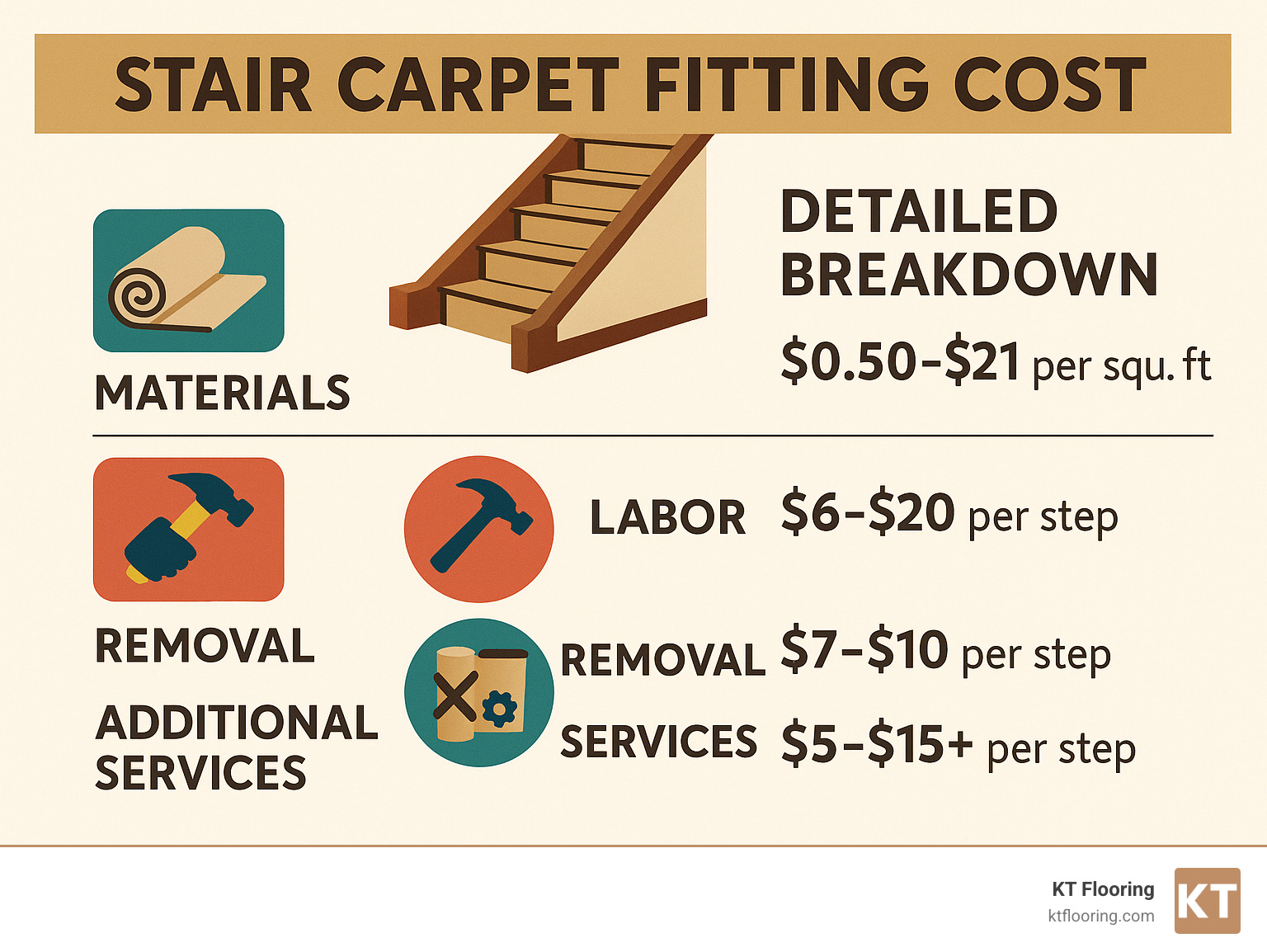
Stair carpet fitting cost ranges from $15-$55 per step, with most homeowners paying between $400-$800 for a complete staircase installation. Here’s what drives these costs:
Quick Cost Breakdown:
– Per Step: $15-$55 (materials + labor)
– Full Staircase (12-16 steps): $180-$880
– Replacement Cost: $22-$65 per step (includes removal)
– Materials Only: $0.50-$21 per square foot
– Labor Only: $6-$20 per step
Your stairs see more foot traffic than any other part of your home. They’re also one of the first things guests notice when they walk through your door. Whether you’re looking to improve safety, reduce noise, or simply update your home’s style, understanding carpet fitting costs helps you budget smartly and avoid surprises.
The complexity of your staircase matters too. Straight stairs cost less than curved or spiral designs. The number of steps, carpet material choice, and whether you need old carpet removed all impact your final bill. These are average costs based on internet data and not actual costs for KT Flooring products and services.
As Christopher Talty, owner of KT Flooring with over 50 years of experience serving New Hampshire and Northeast Massachusetts, I’ve helped countless homeowners steer stair carpet fitting cost decisions that balance comfort, safety, and budget. Our team understands the unique challenges of New England homes and provides transparent pricing for every project.
Terms related to stair carpet fitting cost:
– commercial carpet installation cost
– install carpet
– flooring company
Understanding Stair Carpet Fitting Cost Drivers
Planning a stair carpet project? Let’s break down what really drives stair carpet fitting cost so you can budget with confidence and avoid any surprises along the way.
The biggest factor in your final bill is materials. You’ll find carpet ranging from budget-friendly $0.50 per square foot for basic polyester all the way up to luxurious $21 per square foot for premium wool. Think of it as the foundation of your investment – better materials cost more upfront but often save money in the long run through durability.
Labor costs reflect the specialized skills stair installation demands. Unlike rolling out carpet in a bedroom, stairs require precise measuring, custom cutting, and rock-solid attachment for safety. Professional installers typically charge $6-$20 per step, and honestly, it’s worth every penny when you consider the complexity involved.
Your step count obviously affects the total, but it’s not just simple math. Each step needs individual attention – cutting, fitting, and securing. Most homes have 12-16 steps, though we’ve tackled everything from cozy 8-step designs to impressive 20+ step installations in our 50+ years serving New Hampshire families.
Here’s where things get interesting: stair shape can dramatically change your costs. Straight stairs are your most economical choice, while curved, spiral, or pie-shaped steps require custom cutting that can double or triple material waste. L-shaped and U-shaped stairs with their landings fall somewhere in the middle.
Removing existing carpet adds $1-$5 per square foot to your project, plus disposal fees of about $0.40-$0.50 per square foot. Many homeowners tackle removal themselves to save money – just remember you’ll still need proper disposal.
Don’t overlook underlay and padding at $4-$10 per square foot. Quality padding acts like a shock absorber, extending your carpet’s life while improving comfort underfoot. It’s one of those investments that pays for itself over time.
For stair runners, binding and serging adds $4-$13.50 per linear foot depending on the edge finish you choose. Standard cotton binding keeps costs down, while custom leather or fabric details command premium pricing.
Premium extras like decorative stair rods, custom pattern matching, and specialized treatments can bump your total up by 15-25%. These finishing touches look amazing but require careful budget planning.
Finally, local labor rates vary across our service area. Urban markets typically see higher installation costs than rural New Hampshire communities, though material costs stay fairly consistent.
These are average costs based on internet data and not actual costs for KT Flooring products and services.
For detailed information about our installation process, visit our Stair Carpet Fitting page.
Stair Carpet Fitting Cost vs. Number of Steps
Understanding per-step pricing helps you budget accurately, no matter your staircase size. Here’s how stair carpet fitting cost scales with step count:
11 Steps: $170-$605 total installation
12 Steps: $180-$660 total installation
13 Steps: $195-$715 total installation
14 Steps: $210-$770 total installation
15 Steps: $225-$825 total installation
16 Steps: $240-$880 total installation
17 Steps: $255-$935 total installation
These ranges reflect everything from budget synthetic carpets with basic installation to premium wool with custom cutting and finishing. The wide range gives you flexibility to match your comfort level and budget.
One thing many homeowners don’t expect: waste allowance adds 10-15% to material calculations. Stairs demand precise cuts, and if you’re matching patterns, waste can increase significantly. We always recommend ordering extra material for future repairs or touch-ups.
Landing areas typically add $50-$100 to your project, depending on size. A standard 3×3 foot landing adds about 9 square feet of carpet area plus the extra cutting and fitting labor required.
These pricing estimates are based on industry averages and not specific KT Flooring rates.
Stair Carpet Fitting Cost for Straight vs Complex Stairs
Your staircase design makes a huge difference in both installation complexity and final cost. Here’s what to expect for different configurations:
Straight stairs ($150-$650 total) offer the most budget-friendly installation. Material cuts follow consistent patterns, waste stays minimal, and installation moves along efficiently. Since most residential homes feature straight stairs, this is the most common scenario we see.
L-shaped and U-shaped stairs ($300-$1,000 total) require extra planning and cutting around those turns. The landing where your stairs change direction needs separate measuring and fitting. These designs typically add 15-25% to straight stair costs, but the architectural interest they provide often makes it worthwhile.
Curved stairs ($500-$1,300 total) demand custom cutting for each step’s unique shape. Material waste jumps significantly because standard carpet widths don’t play nicely with curved patterns. Installation time can double or triple compared to straight stairs, but the neat result is often stunning.
Spiral stairs ($700-$1,500 total) represent our most challenging installations. Each step requires individual templating and cutting – it’s almost like creating a custom puzzle piece every time. The continuous curve means virtually no material gets reused between steps, maximizing both waste and labor time.
Pie-shaped steps (also called winders) add complexity wherever they appear. Each pie step costs roughly 25% more than standard rectangular steps due to those tricky custom cutting requirements.
Spindles bump costs by $10-$20 per step. Each one requires careful cutting around its base, and the carpet must fit precisely to prevent gaps or bunching. Staircases with multiple spindles per step see proportionally higher costs.
Custom cuts for architectural details like bullnose edges or decorative trim add both time and material waste. We typically budget an additional 20-30% for heavily detailed staircases – but the finished result often becomes a true showpiece.
Average Stair Carpet Fitting Cost Breakdown (2024)
Let’s talk real numbers. In 2024, stair carpet fitting cost typically runs $15-$55 per step for complete installation. For most New Hampshire homeowners, this means spending between $180-$880 on a typical 12-16 step staircase. Premium installations with luxury materials and custom work can easily reach $2,400 or more.
If you’re replacing existing carpet, expect to pay $22-$65 per step when removal is included. The removal process isn’t just pulling up old carpet—it involves careful disposal, cleaning adhesive residue, and sometimes repairing subflooring underneath.
Labor costs make up a significant chunk of your budget at $6-$20 per step. This reflects the specialized skills needed for stair installation. Your installer isn’t just laying carpet flat—they’re creating precise cuts, working around spindles, and ensuring each step is perfectly secured for safety.
Material costs show the widest variation, ranging from $0.50 per square foot for basic polyester all the way up to $21 per square foot for premium wool. Budget-friendly polyester gets the job done, mid-grade nylon offers excellent durability at $2-$5 per square foot, while luxury wool provides best comfort and natural beauty.
Don’t forget about disposal and cleanup costs. Removing old carpet adds $0.40-$0.50 per square foot, and professional cleanup after installation runs another $0.20-$0.40 per square foot. Most reputable installers include basic cleanup, but extensive prep work costs extra.
Taxes and permits typically add 6-10% to your total project cost. While simple carpet replacement rarely requires permits, it’s worth checking with your local building department if you’re doing extensive renovations.
Here’s how different scenarios compare for a typical 14-step staircase:
| Scenario | Material Cost | Labor Cost | Total Per Step | 14-Step Total |
|---|---|---|---|---|
| Budget | $8-$15 | $6-$10 | $14-$25 | $196-$350 |
| Mid-Range | $15-$30 | $10-$15 | $25-$45 | $350-$630 |
| Premium | $30-$75 | $15-$25 | $45-$100 | $630-$1,400 |
These are average costs based on internet data and not actual costs for KT Flooring products and services.
Materials + Labor Snapshot
Nylon carpet remains our most popular choice for good reason. At $2-$5 per square foot, it delivers excellent durability and stain resistance that holds up beautifully for 8-15 years. Installation proceeds smoothly since nylon behaves predictably during cutting and fitting.
Polyester carpet offers budget-conscious homeowners quality comfort at $1-$3 per square foot. While it won’t last as long as nylon—expect 5-10 years on busy stairs—quality polyester provides good stain resistance and soft feel underfoot. Its lighter weight actually makes installation slightly easier.
Olefin (polypropylene) shines in challenging environments. At $1-$3 per square foot, it resists moisture and fading better than most synthetic options. This makes it perfect for basement stairs or homes with high humidity. The material’s stiffness requires careful handling around curves, but installation otherwise proceeds normally.
Wool carpet represents the luxury end at $4-$20 per square foot. Beyond its natural beauty, wool offers self-cleaning properties and moisture regulation that work wonderfully in New England’s changing seasons. Installation requires extra care to prevent damage, but the results justify the investment.
Sisal and natural fibers bring eco-friendly appeal at $5-$15 per square foot. These materials create unique textures impossible with synthetic options. However, their stiffness and tendency to fray during cutting can increase labor costs as installers use specialized techniques.
Carpet blends strike a middle ground at $1.50-$7 per square foot. Polyester-nylon blends are especially popular, offering improved performance over pure polyester without breaking the budget.
Quality carpet padding costs $4-$10 per square foot but transforms your carpet’s feel and longevity. In New England homes, good padding also provides noise reduction and insulation benefits that make the investment worthwhile.
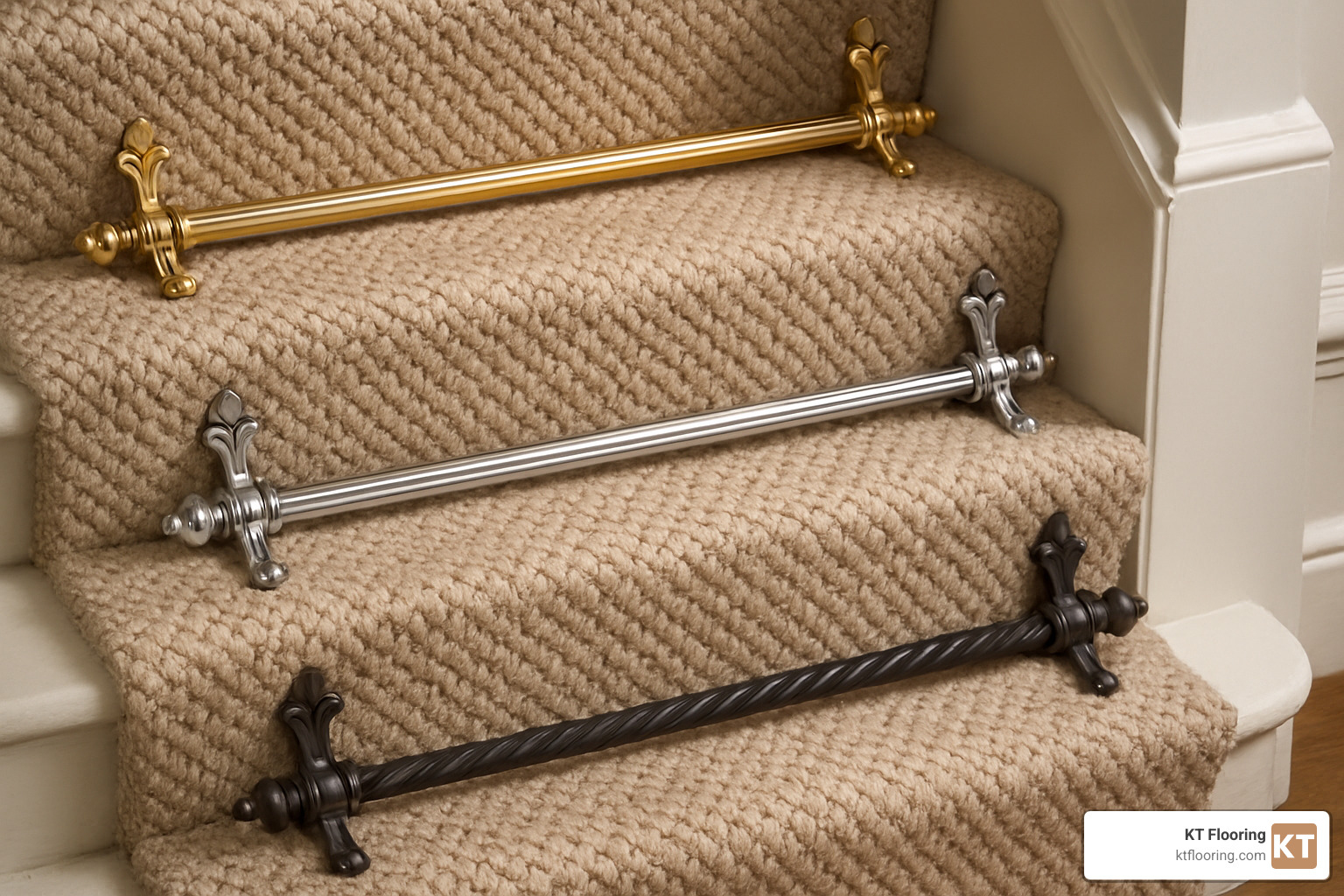
Stair rods range from $15-$150 per rod depending on finish quality. While decorative, they also secure carpet edges and reduce wear patterns that can extend your carpet’s life.
Real-World Case Studies
A DIY-minded homeowner in Nashua spent just $600 total by handling removal themselves and buying remnant carpet. They found quality material for under $200 and hired an independent installer for $400 to handle the tricky installation work on 12 steps plus two small landings.
A Bedford family chose the professional route and invested $1,400 in complete service. They selected $5.49 per square foot carpet for edge-to-edge installation on 14 steps. Professional removal, new padding, and expert installation took just one day. A sale price on quality nylon kept costs reasonable while ensuring professional results.
An upscale Winchester project reached $2,000 with custom-bound runners and pattern matching. The homeowner invested $1,058 in premium materials, $180 for professional binding, $165 for specialized padding, and $600 for expert installation. While expensive, this custom approach achieved a unique look impossible with standard carpet.
Our most typical professional installation starts around $899. This covers straight stairs with basic runner installation—a 27-inch runner at $29.99 per linear foot covering approximately 23 linear feet ($689.77 in materials) plus $299 for professional installation, totaling around $999 before taxes.
These examples reflect actual reported costs but may not represent current KT Flooring pricing.
Material Matters: Carpet Types, Durability & Lifespan
The carpet material you choose makes the biggest difference in your stair carpet fitting cost over time. While premium materials cost more upfront, they often deliver better value through longer lifespans and easier maintenance.
Nylon remains the gold standard for stair carpeting, and for good reason. This workhorse fiber bounces back from heavy foot traffic and keeps looking fresh for 8-15 years. When you consider that stairs get pounded daily by everyone in your household, nylon’s resilience makes financial sense. The fiber bends without breaking, which means those sharp stair edges won’t destroy your carpet in a few years.
Polyester offers the sweet spot for budget-conscious homeowners who still want decent performance. Modern polyester carpets resist stains beautifully and can handle 5-10 years of stair duty. The catch? Polyester tends to get that “walked-on” look faster than nylon, especially on those high-wear stair nosings where everyone steps. But if you’re planning to redecorate in a few years anyway, polyester delivers solid value.
Wool brings luxury and longevity to your stairs. This natural fiber actually cleans itself to some degree and handles New England’s humidity changes like a champ. Wool carpets can last 8-20 years when properly cared for. The material feels amazing underfoot and brings that timeless elegance that never goes out of style. Just remember that wool needs a bit more TLC than synthetic options.
Olefin excels in challenging environments where moisture or stains are concerns. Got stairs leading to a basement or pool area? Olefin laughs at humidity and spills. This tough synthetic fiber resists fading and cleans up easily, lasting 5-12 years even in demanding conditions. It might not feel as plush as wool, but it’s practically bulletproof.
Natural fibers like sisal appeal to eco-conscious homeowners who want unique textures. These materials bring character and sustainability to your stairs. They’re tough as nails and provide excellent traction. The trade-off? They can feel rough on bare feet and require specialized cleaning approaches.
Construction matters as much as fiber type. Flat-weave carpets resist crushing on stair edges, keeping that crisp appearance longer. Berber styles hide footprints and wear patterns, though they can snag on pet claws. For homes with furry family members, smooth cut-pile or flat-weave options prove more practical.
Lifecycle costs tell the real story. That $15-per-square-foot nylon might seem expensive compared to $3-per-square-foot polyester, but if the nylon lasts twice as long, you’re actually saving money. Plus, you avoid the hassle and expense of early replacement.
For detailed insights on material selection and real-world performance, this comprehensive guide offers valuable perspective: Latest advice on stair runners
Pros & Cons at a Glance
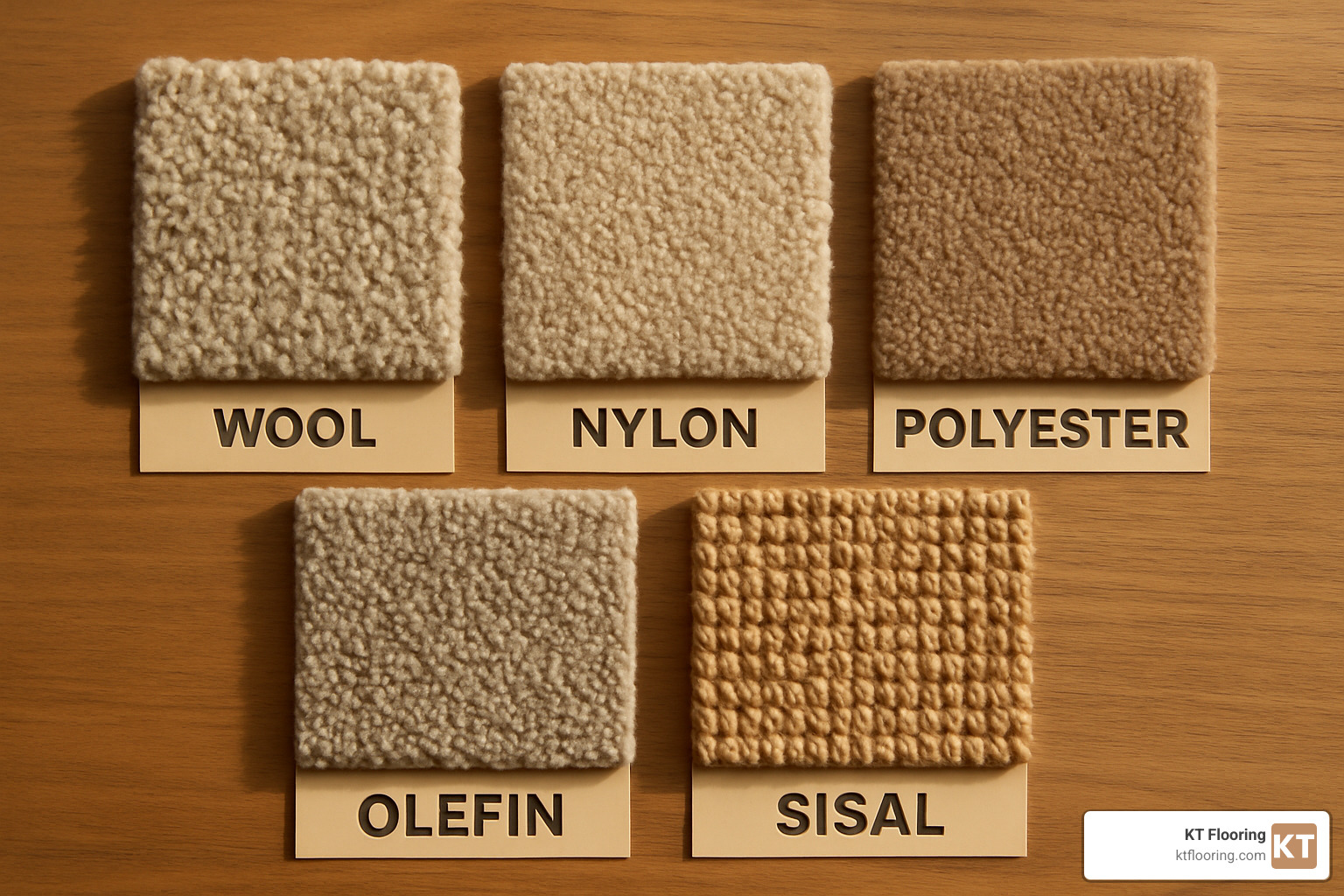
When it comes to comfort under your feet, wool takes the crown with its natural softness and temperature regulation. You’ll feel the difference immediately, especially during those chilly New England mornings. Nylon delivers excellent cushioning while maintaining its bounce-back qualities. Polyester starts soft but tends to pack down over time, while olefin feels firmer but stays consistent. Natural fibers like sisal provide texture and grip but less cushioning.
Cleaning becomes a daily reality with stairs, so choose wisely. Olefin and treated nylon handle spills and muddy shoes like champions. Most stains wipe away without drama. Quality polyester and treated wool perform well with regular maintenance, though wool needs gentler cleaning products. Natural fibers require the most care and specialized cleaning approaches.
Allergy sufferers should focus on materials that don’t trap dust and pet dander. Low-pile nylon and olefin work best here, as they don’t create hiding spots for allergens. Tightly woven materials of any type perform better than high-pile options that act like dust magnets.
Durability in high-traffic areas separates the winners from the wannabes. Nylon and flat-weave constructions handle whatever your family dishes out. Quality polyester and wool deliver good performance with proper care. Basic polyester and some natural fibers may show wear sooner but can still provide decent service for lighter-traffic households.
Choosing the Right Underlay
The padding beneath your carpet works harder than you might think. Quality underlay can extend your carpet’s life by 50% while making every step more comfortable. It’s one of those behind-the-scenes investments that pays dividends daily.
Rubber padding costs more at $6-$10 per square foot but delivers premium performance. This dense material supports heavy traffic without compressing, making it perfect under wool or nylon carpets. Rubber padding also resists moisture, which matters in humid New England summers or if you track in snow.
Felt padding offers solid performance at $4-$8 per square foot. Recycled felt options provide environmental benefits while supporting most residential carpet installations. Felt works particularly well with synthetic carpets, though it may compress under very heavy use.
Thickness requires careful consideration on stairs. Thicker padding (7/16 inch) feels luxurious but can create wobbly edges that pose safety risks. Thinner options (1/4 to 3/8 inch) provide better edge stability while still delivering cushioning and insulation benefits.
Sound control becomes crucial in multi-story homes. Quality padding reduces noise transmission by 20-30%, which your family (and neighbors) will appreciate. This benefit proves especially valuable in townhomes or when teenagers stomp up and down stairs.
Warranty protection often depends on using manufacturer-approved padding. Many carpet warranties become void if you skimp on padding or choose inappropriate types. We always verify warranty requirements before recommending padding options, ensuring your investment stays protected.
These padding costs represent average market pricing and not specific KT Flooring rates.
Smart Ways to Save on Stair Carpet Fitting Cost
Nobody wants to overpay for carpet installation, especially when smart planning can deliver professional results for less. After 50 years in the flooring business, we’ve seen homeowners save hundreds of dollars on stair carpet fitting cost without sacrificing quality.
DIY removal represents the easiest way to trim your budget. Pulling up old carpet yourself saves $1-$5 per square foot in labor costs. Most homeowners can handle this weekend project with basic tools, though you’ll still need to factor in disposal fees. Take your time removing old tack strips to avoid damaging the stairs underneath – those gouges can cost extra to repair later.
Remnant shopping opens doors to premium materials at budget prices. Local carpet stores often sell remnants at 30-50% discounts, and stairs typically require less material than full rooms anyway. We’ve helped customers find $8-per-square-foot nylon remnants for $3 per square foot. The key is being flexible with color and pattern choices.
Choosing runners over full coverage can slash material costs nearly in half. A standard 27-inch runner covers the walking surface while leaving attractive wood edges exposed. This classic look works beautifully in traditional homes and costs significantly less than edge-to-edge installation.
Off-season timing matters more than you might think. Booking installation during late fall or winter often yields better pricing and scheduling flexibility. Contractors appreciate steady work during slower periods and may offer discounts for projects that help fill their calendars.
Getting multiple quotes protects against overpricing, but the lowest bid isn’t always the best value. Extremely cheap estimates often indicate corners being cut on materials or installation quality. We recommend gathering at least three detailed quotes that break down materials, labor, and extras separately.
Working with local installers frequently provides better value than national chains. Independent contractors typically have lower overhead and can offer more personalized service. Just verify their insurance and licensing before signing any contracts.
The waterfall method wraps carpet smoothly over stair nosings for a flowing appearance, while the Hollywood method creates crisp, clean lines with potentially lower material usage. Your installer can explain which approach works best for your specific stairs and budget.
For professional estimates and consultation, visit our Request Estimate page.
DIY vs Professional: Risk-Reward
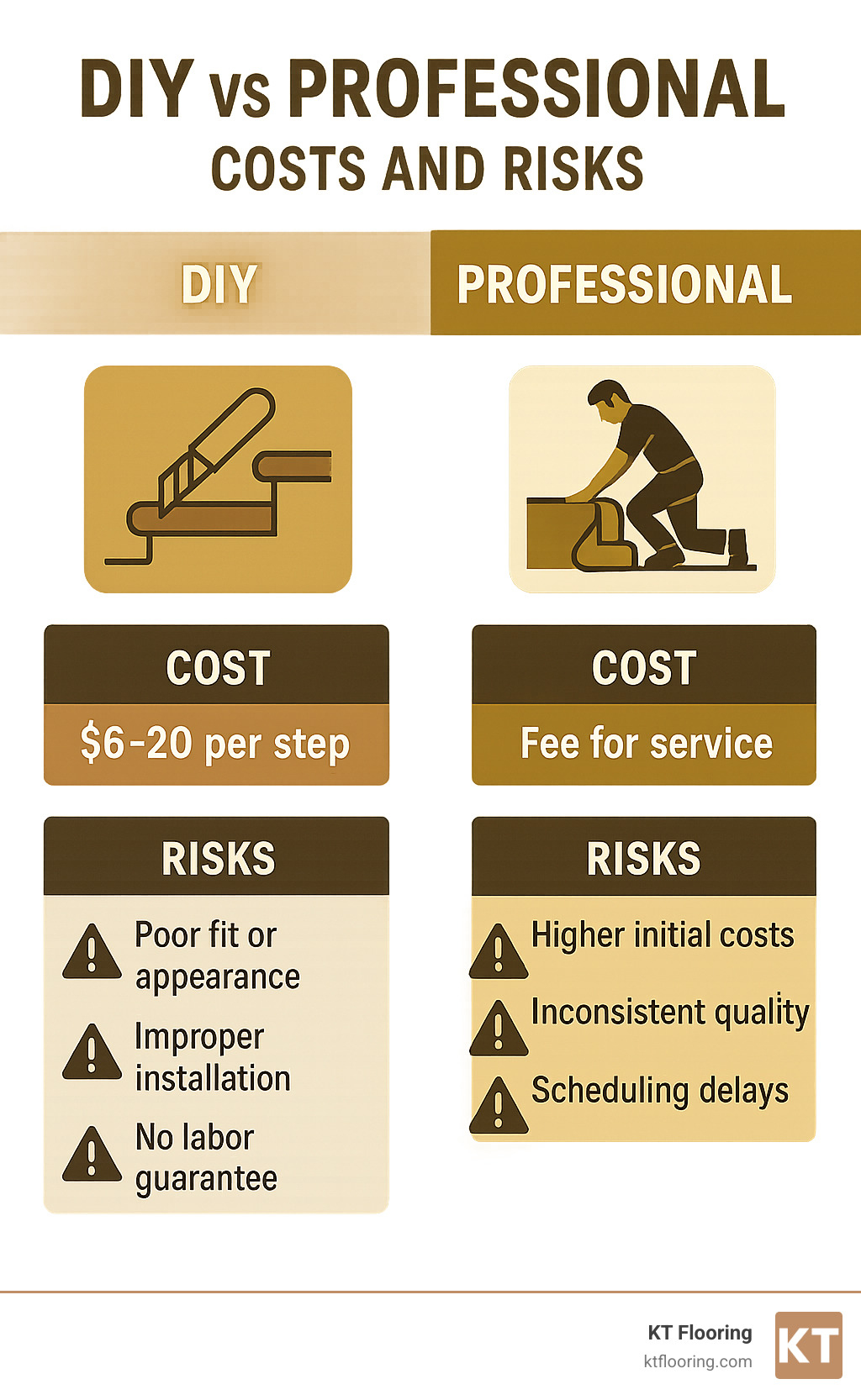
The DIY route can save you $6-$20 per step in labor costs, but it’s not right for every homeowner or every staircase. Let’s be honest about what you’re getting into.
DIY installation gives you complete control over timing and quality while providing genuine satisfaction from completing the project yourself. You can work around your family’s schedule and take extra time on tricky areas. However, you’ll need to rent specialized tools like a power stretcher ($50-$200 rental cost), and mistakes can be expensive to fix.
Professional installation brings expertise, proper tools, and insurance coverage to your project. A typical 12-step staircase takes professionals 4-8 hours to complete, while DIY installation often requires a full weekend or longer. Professionals also provide warranty coverage on their workmanship.
Here’s a realistic cost comparison: DIY materials plus tool rental typically runs $600-$800, while professional installation costs $800-$1,200. That $200-$400 difference buys you expertise, speed, and peace of mind.
Choose DIY if you have straight stairs with standard dimensions, previous carpet experience, and a flexible timeline. It’s also the right choice when budget constraints require maximum savings.
Hire professionals for complex stair configurations, expensive carpet materials, or when warranty requirements mandate professional installation. If you’re short on time or uncomfortable working on stairs, the professional route makes sense.
Some carpet warranties become void with DIY installation, potentially costing more than professional installation would have cost initially.
Extra Touches Worth the Splurge
Some upgrades provide enough value to justify their cost, especially when you’re planning to stay in your home for years.
Premium binding at $11.50-$13.50 per linear foot transforms standard runners into custom installations. Wide cotton binding or leather edges create distinctive appearances that complement high-end décor. The investment often pays dividends in perceived value and durability, especially in formal entryways.
Decorative stair rods ranging from $50-$150 each add elegance while serving practical purposes. Quality brass or wrought iron rods secure carpet edges and can actually extend carpet life by reducing edge wear. Choose finishes that match your existing hardware for a cohesive look throughout your home.
Pattern matching requires 15-20% additional material but creates seamless appearances that look truly professional. If you’ve invested in patterned carpet, proper pattern matching ensures the investment shows to its best advantage.
Custom serging provides an alternative to standard binding with unique edge treatments. Serged edges offer excellent durability while maintaining clean lines. This option works particularly well with solid-color carpets where binding might create visual interruption.
These extras aren’t necessary for every installation, but they can transform a basic carpet project into something that adds real value to your home.
FAQs About Stair Carpet Fitting Cost
How long does installation take?
Most homeowners are surprised to learn that professional stair carpet fitting cost includes relatively quick installation times. A typical 12-16 step staircase takes just 4-8 hours from start to finish, making it a manageable one-day project for most families.
Straight staircases move along much faster than complex designs. Our installers can usually complete a standard 12-step straight staircase in about 4 hours, including all the cutting, fitting, and cleanup. That means you can have breakfast on bare stairs and dinner on beautiful new carpet!
Preparation work adds another 1-2 hours to your timeline, especially if we’re removing old carpet first. This prep time isn’t wasted though – proper surface preparation prevents future problems and ensures your new carpet looks great for years to come.
Several factors can extend installation time beyond the basics. Complex stair shapes like curved or spiral designs require custom cutting for each step, potentially doubling the installation time. Multiple landings need separate measurement and fitting. If you’re adding premium features like pattern matching or decorative binding, expect additional time for these finishing touches.
What makes stair carpet pricier than room carpet?
Many homeowners wonder why stair carpet fitting cost runs higher per square foot than regular room installations. The answer lies in the specialized skills and extra challenges that stairs present.
Precision cutting creates the biggest cost difference. While room carpet installation involves large pieces that cover extensive areas efficiently, stairs require individual measurement and cutting for each step. This detailed work increases both material waste and installation time significantly.
Vertical installation presents unique challenges that don’t exist with flat floors. Our installers must secure carpet against gravity while maintaining proper tension and perfect alignment. The specialized techniques and extra attention required justify higher labor rates compared to standard room installations.
Safety requirements demand extra care that you simply don’t need with room carpet. Loose or improperly secured stair carpet creates serious safety hazards, so we use more tack strips and spend additional time on edge work to ensure everything stays perfectly in place.
Spindle work around balusters adds another layer of complexity. Each spindle requires individual templating and precise cutting to achieve clean, professional results. This intricate work can add significant time to projects, especially on staircases with multiple spindles per step.
How often will I need to replace stair carpet?
The lifespan of your stair carpet investment varies dramatically based on several key factors, but most quality installations last 5-20 years with proper care. Understanding these factors helps you choose materials that match your family’s needs and budget expectations.
Traffic levels play the biggest role in determining replacement timing. A light-use staircase in a home with an elderly couple might last 15-20 years, while a busy family staircase with children and pets typically needs replacement every 5-8 years. Most families with moderate traffic can expect 8-12 years from quality carpet.
Material quality directly impacts longevity and your long-term stair carpet fitting cost. Budget synthetic carpets usually last 5-8 years, while mid-grade nylon averages 8-12 years of good performance. Premium wool installations can provide 10-20 years of beauty and comfort, making them excellent long-term investments despite higher upfront costs.
Maintenance habits can literally double your carpet’s lifespan. Regular vacuuming removes abrasive dirt particles that wear down fibers. Prompt stain treatment prevents permanent damage. Professional cleaning every 12-18 months keeps carpets looking fresh and extends their useful life significantly.
The nose of each step typically shows wear first, since it receives the most foot contact. Quality installation techniques and proper padding help distribute wear more evenly, extending overall carpet life and protecting your investment.
Conclusion
Making smart decisions about stair carpet fitting cost comes down to understanding your options and finding the sweet spot between budget and quality. With typical investments ranging from $400-$800 for complete installations, you’re not just buying carpet – you’re investing in your family’s daily safety, comfort, and your home’s overall appeal.
The numbers tell an important story. While those budget-friendly $15 per step options might seem tempting, your stairs work harder than any other surface in your home. Premium installations at $55+ per step often deliver better long-term value through superior durability and extended lifespan. It’s like the old saying – you can pay a little now or a lot later.
Material choice makes all the difference. That wool carpet might cost more upfront, but when it’s still looking great after 15 years while cheaper options need replacement twice, the math works in your favor. Quality nylon strikes a nice middle ground for most families, offering excellent durability without the premium price tag.
At KT Flooring, we’ve spent over 50 years helping New Hampshire and Northeast Massachusetts families steer these decisions. We’ve seen the disappointment when homeowners cut corners, and we’ve witnessed the satisfaction when they invest wisely. Our experience has taught us that the best stair carpet fitting cost decisions consider both your immediate budget and your long-term happiness with the results.
Every home tells a different story. Your busy family household with kids and pets has different needs than empty nesters who entertain occasionally. Your historic colonial presents different challenges than your contemporary split-level. That’s why we believe in taking time to understand your specific situation before making recommendations.
Whether you’re tackling a single staircase or planning a whole-home renovation, proper planning and professional installation ensure results that improve your daily life. There’s something wonderful about walking up stairs that feel secure underfoot, look beautiful, and reduce the noise that travels through your home.
Ready to explore your options? We’d love to help you find the perfect balance of comfort, style, and value for your home. Contact us today for a personalized consultation where we can discuss your specific needs and provide a detailed estimate based on your actual project.
For more information about our complete range of carpet options and services, visit our Carpet Flooring page.
All pricing mentioned represents average market costs based on internet research and industry data, not specific KT Flooring rates. Contact us for current pricing on your specific project.
