The Real Cost of Adding Comfort Underfoot
The average cost of carpeting a house ranges from $2 to $8 per square foot installed, with most homeowners spending between $1,800 and $7,500 to carpet a 1,000 square foot home. Here’s a quick breakdown:
| Carpet Grade | Material Cost | Installed Cost (per sq ft) | 10×12 Room Total |
|---|---|---|---|
| Economy | $0.50-$1.50 | $2.00-$3.50 | $240-$420 |
| Mid-grade | $1.50-$6.00 | $3.50-$6.00 | $420-$720 |
| Premium | $6.00-$21.00 | $7.00-$12.00 | $840-$1,440 |
When planning your flooring budget, understanding the average cost of carpeting a house involves more than just the price per square foot. It includes material quality, padding, installation labor, removal of old flooring, and potential subfloor preparation. Each of these elements contributes to both your immediate investment and the long-term value of your home.
The price spectrum is wide because carpeting isn’t one-size-fits-all. A cozy bedroom might warrant different carpeting than a high-traffic living room or moisture-prone basement. Your choices in fiber type, pile height, and density will significantly impact both comfort and cost.
I’m Christopher Talty, owner of KT Flooring, and with over 50 years of experience in the flooring industry throughout New Hampshire and Northeast Massachusetts, I’ve helped thousands of homeowners steer the average cost of carpeting a house while finding the perfect balance of quality, comfort, and value for their specific needs.
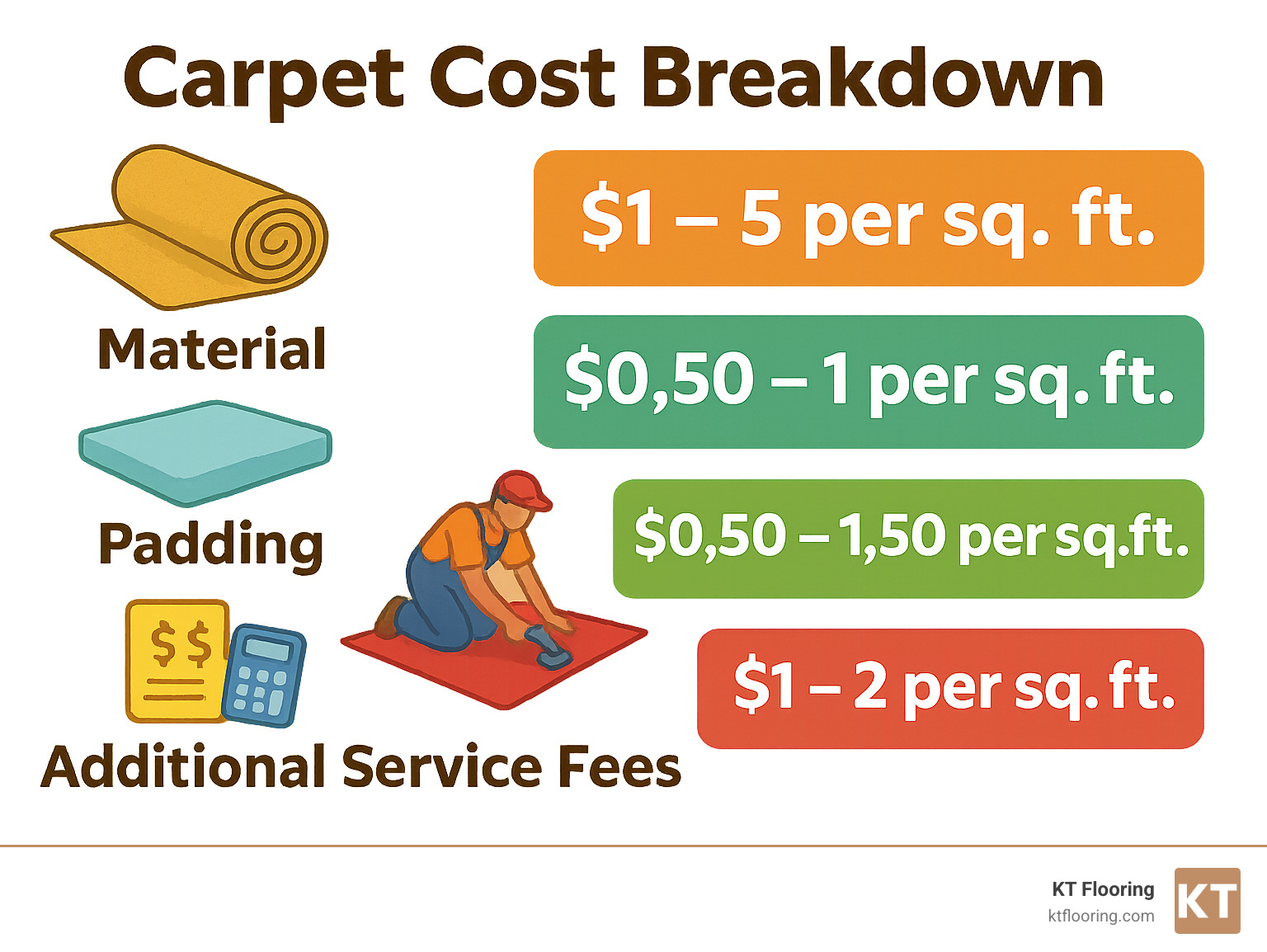
Average cost of carpeting a house terms explained:
– install carpet
– stair carpet fitting
– flooring company
Average Cost of Carpeting a House in 2024–2025
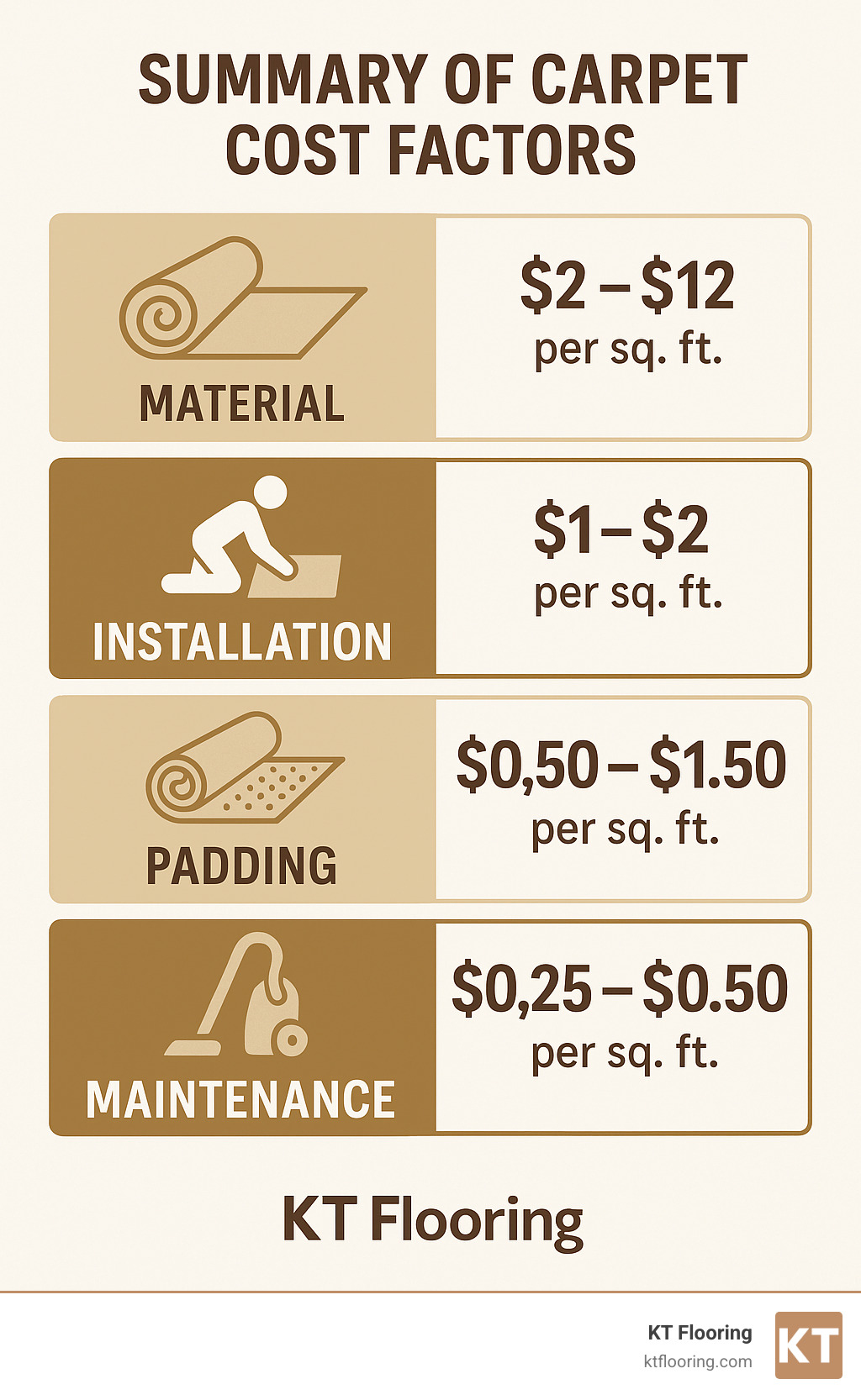
Let’s talk real numbers about what you might spend to bring that soft, cozy carpet into your home. The average cost of carpeting a house currently sits around $6.35 per square foot when everything’s said and done. But don’t get too attached to that figure—actual costs typically range between $2 and $8 per square foot, depending on what you choose.
For a typical 1,000 square foot carpet job (think main living areas and bedrooms), most homeowners invest between $1,800 and $7,500. That’s quite a spread, right? The difference comes down to whether you’re choosing budget-friendly basics or premium materials that will stand the test of time.
I should note that these figures represent national averages based on industry data, not KT Flooring’s specific pricing. For an accurate quote custom to your home’s unique needs, our consultants would be happy to provide personalized guidance.
Here’s how the numbers typically break down across different quality levels:
| Quality Level | Material Cost | Padding Cost | Installation | Total Installed |
|---|---|---|---|---|
| Builder-Grade | $0.50-$1.50/sq ft | $0.25-$0.50/sq ft | $0.50-$1.50/sq ft | $1.25-$3.50/sq ft |
| Mid-Grade | $1.50-$6.00/sq ft | $0.50-$0.75/sq ft | $0.75-$1.75/sq ft | $2.75-$8.50/sq ft |
| Premium | $6.00-$21.00/sq ft | $0.75-$1.20/sq ft | $1.00-$2.25/sq ft | $7.75-$24.45/sq ft |
When thinking about value, builder-grade carpet typically lasts 3-5 years, mid-grade serves you well for 6-12 years, and premium options can keep looking great for 12-20+ years. Sometimes spending a bit more upfront for your busy family room might actually save money in the long run!
Room-by-Room Breakdown: average cost of carpeting a house per space
Your bedroom needs different carpeting than your basement or stairway. Let’s walk through what you might expect to pay for various spaces in your home.
That cozy 10×12 bedroom (120 sq ft) might cost between $200-$420 for budget-friendly options, $330-$720 for something mid-range, or $930-$1,440 if you’re treating yourself to premium comfort.
For a home office (12×12 = 144 sq ft), plan on $240-$504 for economy options that’ll handle your office chair wheels, $396-$864 for mid-grade, or $1,116-$1,728 for premium carpeting.
Your living room (typically 15×20 = 300 sq ft) represents a bigger investment: $600-$1,050 for economy grades, $1,050-$1,800 for mid-range, or $2,325-$3,600 for premium materials that can handle all those family movie nights.
Basement spaces (often around 600 sq ft) require special consideration. Economy options run $1,200-$2,100 (look for moisture-resistant varieties), mid-grade costs $2,100-$3,600 (with padding appropriate for concrete subfloors), while premium solutions with excellent moisture barriers range from $4,650-$7,200.
Stairs deserve special attention because they’re trickier to carpet. A standard 13-step staircase costs $150-$600 for basic installation, while custom fitting ranges from $300-$910 (about $11-$26 per step plus materials). For more details, check out our stair carpet fitting cost guide.
Apartments typically run $1,200-$1,500 to carpet, while mobile homes present unique challenges. Single-wides (600-800 sq ft) generally cost $1,200-$2,800, and double-wides (1,000-1,400 sq ft) range from $2,000-$4,900. We recommend wider carpet rolls (14-16 feet) for these spaces to minimize seams in narrow areas—something our technicians are well-versed in handling throughout Southern New Hampshire and Northeast Massachusetts.
Whole-House Estimates: average cost of carpeting a house by size
When planning a whole-house carpet project, most homes don’t carpet every square inch. Kitchens, bathrooms, and often entryways typically get hard flooring. Here’s a realistic breakdown:
For an 800 sq ft condo (carpeting about 80% = 640 sq ft), budget between $1,280-$2,240 for economy options, $2,240-$3,840 for mid-grade, or $4,960-$7,680 for premium materials.
A 1,500 sq ft ranch-style home (carpeting roughly 70% = 1,050 sq ft) would run $2,100-$3,675 for budget-friendly carpeting, $3,675-$6,300 for mid-range, or $8,137-$12,600 for top-tier options.
If you have a 2,000 sq ft colonial (carpeting approximately 60% = 1,200 sq ft), plan on $2,400-$4,200 for economy grade, $4,200-$7,200 for mid-grade, or $9,300-$14,400 for premium carpeting.
For a typical 3-bedroom home (around 1,800 sq ft, with 60% carpeted = 1,080 sq ft), expect costs of $2,160-$3,780 for economy options, $3,780-$6,480 for mid-grade, or $8,370-$12,960 for premium materials.
These estimates include standard installation but might not cover extensive furniture moving, old carpet removal, or subfloor preparation. For a complete picture of what your specific project might cost, I’d recommend scheduling a carpet installation New Hampshire consultation with our experienced team.
What Drives Carpet Pricing?
Understanding the factors that influence the average cost of carpeting a house helps you make informed decisions and potentially save money without sacrificing quality. Here are the key elements that determine your final price:
Material Quality and Face Weight
The biggest price determinant is the carpet material itself. Face weight (measured in ounces per square yard) indicates density and durability:
* Under 30 oz: Economy grade, typically lasts less than 7 years
* 30-40 oz: Mid-grade, lasts 7-12 years
* Over 40 oz: Premium grade, lasts 12+ years
Pile Height and Style
Different carpet styles come with different price points:
* Berber/Loop Pile: $5.00-$7.50 per sq ft installed
* Cut Pile Textured: $5.65 per sq ft average
* Plush/Saxony: $6.00-$8.00 per sq ft installed
* Frieze/Shag: $6.50-$9.00 per sq ft installed
* Pattern Cut & Loop: $7.00-$9.50 per sq ft installed
Padding Quality
Quality padding extends carpet life and improves comfort:
* Basic Synthetic: $0.25-$0.50 per sq ft
* Standard Rebond: $0.50-$0.75 per sq ft
* Premium Memory Foam: $0.75-$1.20 per sq ft
* Moisture-Barrier Padding: $0.90-$1.50 per sq ft (recommended for basements)
Installation Complexity
- Basic rectangular rooms: Standard labor rates
- Stairs: Additional $1-$2 per sq ft or $11-$26 per step
- Custom cuts for irregular rooms: Extra $1-$2 per sq ft
- Pattern matching: Additional labor charges
Additional Services
- Old carpet removal and disposal: $0.70-$1.60 per sq ft
- Furniture moving: $25-$75 per room
- Subfloor repair: Average $600 for minor repairs, $3-$10 per sq ft for replacement
- Stain-resistant treatments: Approximately $80 per 1,000 sq ft
Regional Variations
Labor costs vary significantly by region. In the Northeast, particularly in New Hampshire and Massachusetts where we operate, labor rates tend to be slightly higher than the national average due to the cost of living and stringent building codes.
For a comprehensive overview of our carpet options, visit our carpet flooring page.
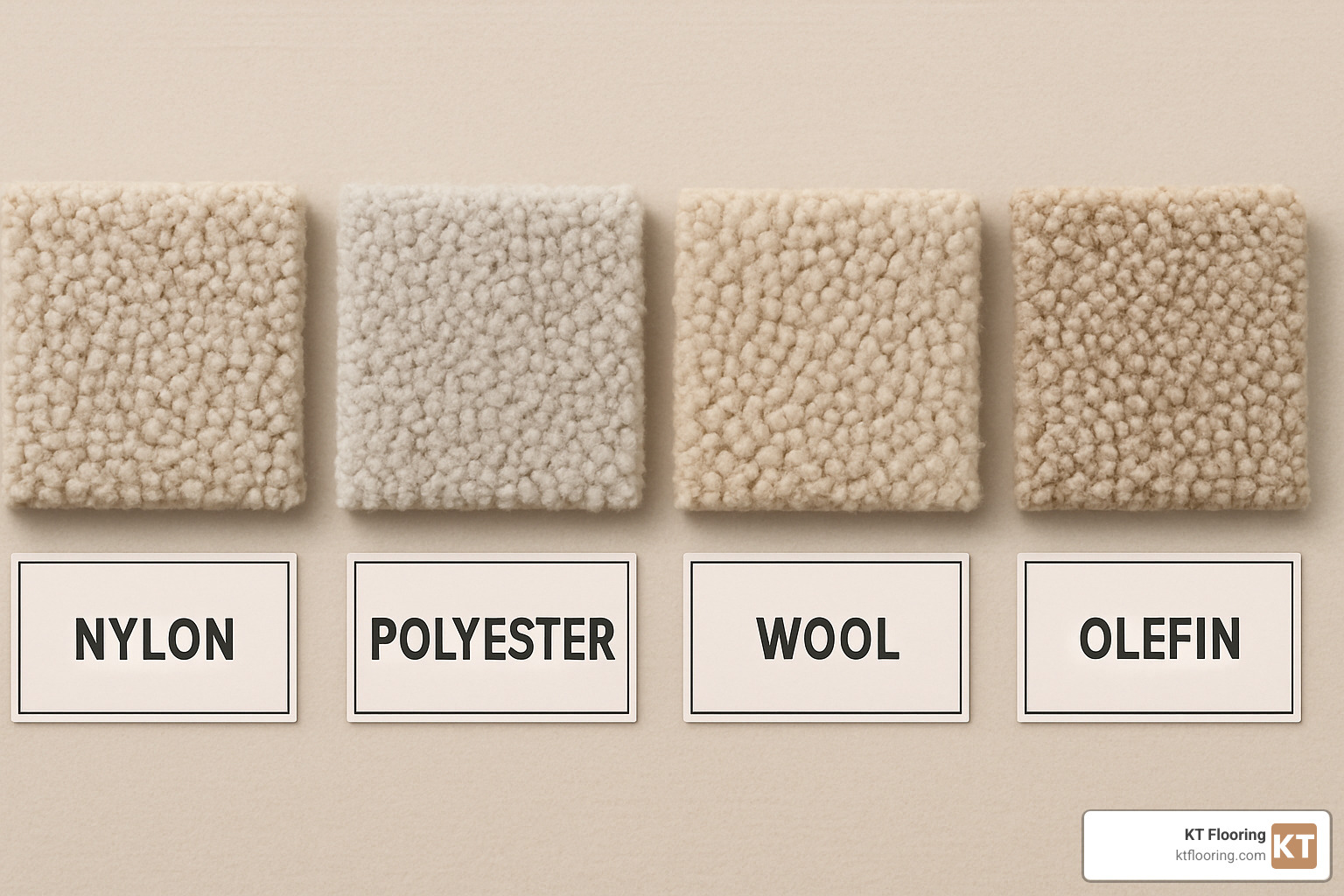
Fiber & Material Costs
The type of fiber you choose significantly impacts both the initial cost and long-term value of your carpet. Here’s a breakdown of the most common carpet materials and their associated costs:
Nylon ($0.75-$9.00 per sq ft)
Nylon remains the most popular carpet fiber due to its exceptional durability and resilience.
* Pros: Highly durable, excellent resilience, good stain resistance when treated
* Cons: More expensive than polyester and olefin
* Best for: High-traffic areas, homes with children and pets
* Lifespan: 10-15 years with proper care
Polyester ($1.00-$4.00 per sq ft)
Polyester offers good value and excellent stain resistance at a lower price point.
* Pros: Naturally stain-resistant, soft, eco-friendly options available
* Cons: Less resilient than nylon, tends to crush under heavy furniture
* Best for: Bedrooms, low-traffic areas, budget-conscious homeowners
* Lifespan: 5-10 years
Olefin/Polypropylene ($1.00-$3.00 per sq ft)
This budget-friendly option is highly resistant to moisture and staining.
* Pros: Excellent moisture resistance, colorfast, resists static
* Cons: Less durable than nylon, can appear matted quickly
* Best for: Basements, sunrooms, indoor/outdoor spaces
* Lifespan: 3-8 years
Triexta/SmartStrand ($1.50-$7.00 per sq ft)
A newer fiber that combines durability with built-in stain resistance.
* Pros: Permanent stain resistance, good durability, partially plant-based
* Cons: Still relatively new to market, premium pricing
* Best for: Active households with children and pets
* Lifespan: 10-20 years
Wool ($3.00-$21.00+ per sq ft)
The premium natural fiber option, offering best luxury and longevity.
* Pros: Luxurious feel, naturally flame-resistant, excellent resilience
* Cons: Expensive, can be susceptible to staining
* Best for: Low-traffic formal areas, master bedrooms, allergy sufferers
* Lifespan: 15-30 years with proper care
Sisal and Other Natural Fibers ($4.00-$15.00 per sq ft)
These eco-friendly options provide unique textures and sustainable benefits.
* Pros: Sustainable, unique appearance, biodegradable
* Cons: Can be rough underfoot, more difficult to clean
* Best for: Low-traffic areas, eco-conscious homeowners
* Lifespan: 7-15 years depending on use
For those with allergies or environmental concerns, hypoallergenic options are available across several fiber types. Wool is naturally hypoallergenic, while many synthetic carpets now come with low-VOC certifications that minimize off-gassing. These eco-friendly options typically add 10-30% to the base material cost.
According to recent market research from Floor Covering Weekly, nylon continues to dominate residential installations, accounting for approximately 45% of the market, followed by polyester at 30%, with wool and specialty fibers making up smaller segments.
Padding & Underlayment Essentials
Padding is far more than just a comfort layer—it’s a critical component that protects your carpet investment. Quality padding can extend carpet life by up to 50% by reducing fiber crushing and backing deterioration.
Padding Costs and Types
* Rebond (recycled foam): $0.25-$0.55 per sq ft – Most common residential option
* Urethane foam: $0.30-$0.80 per sq ft – Available in various densities
* Memory foam: $0.60-$1.00 per sq ft – Premium comfort option
* Fiber cushion: $0.50-$0.90 per sq ft – Firm, stable option for loop carpets
* Rubber: $0.75-$1.20 per sq ft – Premium durability and moisture resistance
Density and Thickness Considerations
* Residential padding typically ranges from 3/8″ to 7/16″ thick
* Density is measured in pounds per cubic foot:
* Light traffic: 5-6 lb density
* Medium traffic: 6-8 lb density
* Heavy traffic: 8-10 lb density
Special Applications
* Concrete subfloors: Moisture-barrier padding recommended, adding $0.15-$0.30 per sq ft
* Radiant heating: Special thin, dense padding required, adding $0.20-$0.40 per sq ft
* Pet-prone areas: Waterproof membrane padding available, adding $0.30-$0.50 per sq ft
The padding quality should match or complement your carpet quality. Investing in premium padding with economy carpet often makes more sense than pairing premium carpet with basic padding. For professional guidance on padding selection, visit our install carpet page.
Labor and Add-On Services
Professional installation ensures your carpet performs as expected and maintains warranty coverage. Here’s what to expect for labor and additional services:
Basic Installation Labor
* Standard residential installation: $0.50-$1.50 per sq ft
* Commercial installation: $0.75-$2.25 per sq ft
* Average hourly rate: $35-$80 per hour
Old Carpet Removal and Disposal
* Removal only: $0.25-$0.50 per sq ft
* Removal with disposal: $0.70-$1.60 per sq ft
* Some municipalities charge additional dump fees
Subfloor Preparation
* Minor repairs (patching, nail removal): $100-$300 total
* Moderate repairs (small sections): $300-$600 total
* Major repairs or replacement: $3-$10 per sq ft
* Concrete sealing/moisture barrier: $0.50-$1.00 per sq ft
Furniture Moving
* Small room: $25-$45
* Medium room: $45-$60
* Large room: $60-$75
* Heavy items (pianos, large armoires): $100-$300 each
Specialty Installation
* Stairs: $11-$26 per step
* Custom borders: $2-$5 additional per linear foot
* Pattern matching: 10-15% additional labor
* Custom cuts for irregular rooms: $1-$2 additional per sq ft
Additional Services
* Stain protection treatment: $0.20-$0.40 per sq ft
* Carpet stretching (existing carpet): $0.30-$0.75 per sq ft
* Transition strip installation: $2-$5 per linear foot
* Vent cutouts: $5-$15 each
For commercial projects with specific requirements, our commercial carpet installation cost page provides detailed information custom to business environments.
DIY vs. Professional Installation: Saving or Spending Smart?
Many homeowners consider DIY carpet installation to save on labor costs, but is it truly cost-effective? Let’s examine both approaches to help you make an informed decision.
DIY Carpet Installation: The Real Costs
While DIY installation eliminates labor costs ($0.50-$1.50 per sq ft), it introduces other expenses:
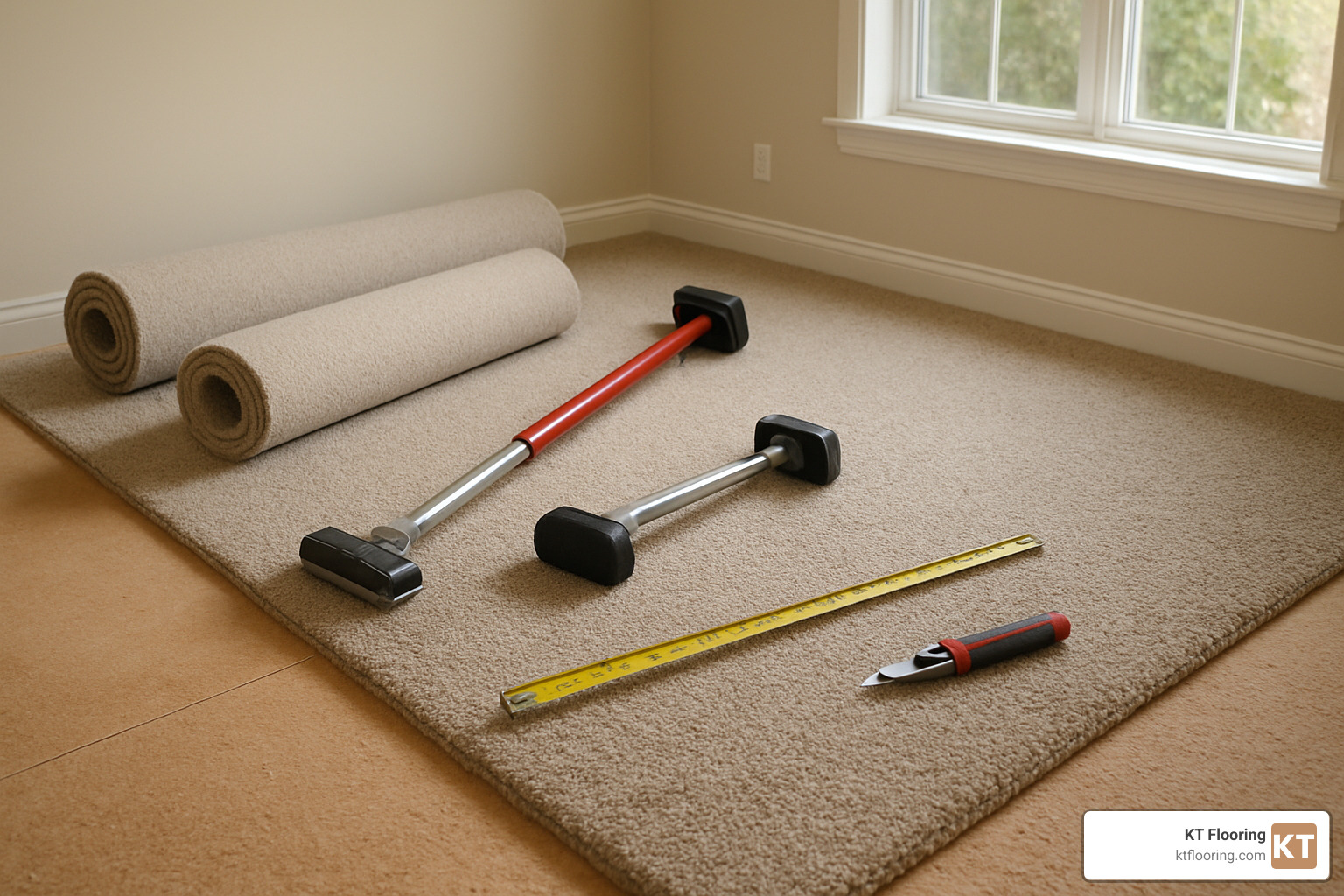
- Tool rental: $85-$200 per day (power stretcher, knee kicker, seam iron)
- Additional materials: $0.30-$0.50 per sq ft (seam tape, tack strips, adhesives)
- Waste factor: 15-20% (vs. 10-15% professional) due to inexperience
- Time investment: 2-3 times longer than professional installation
- Potential for mistakes: Re-stretching costs average $0.30-$0.75 per sq ft
Professional Installation Benefits
Professional installation offers several advantages that often justify the cost:
- Proper stretching prevents future rippling and premature wear
- Precise seam placement and execution for nearly invisible joins
- Efficient material use (less waste)
- Warranty protection (many manufacturers void warranties on DIY installations)
- Proper transition fitting between different flooring types
- Included furniture moving and old carpet removal
- Typically completed in 1 day vs. 2-3 days for DIY
With over 50 years of experience, our installation teams at KT Flooring have the specialized tools and expertise to ensure your carpet is installed correctly the first time, saving you potential headaches and expenses down the road.
Cost Gap Analysis: DIY vs Pro for the average cost of carpeting a house
To truly understand the cost difference between DIY and professional installation, let’s analyze a typical 1,000 square foot installation:
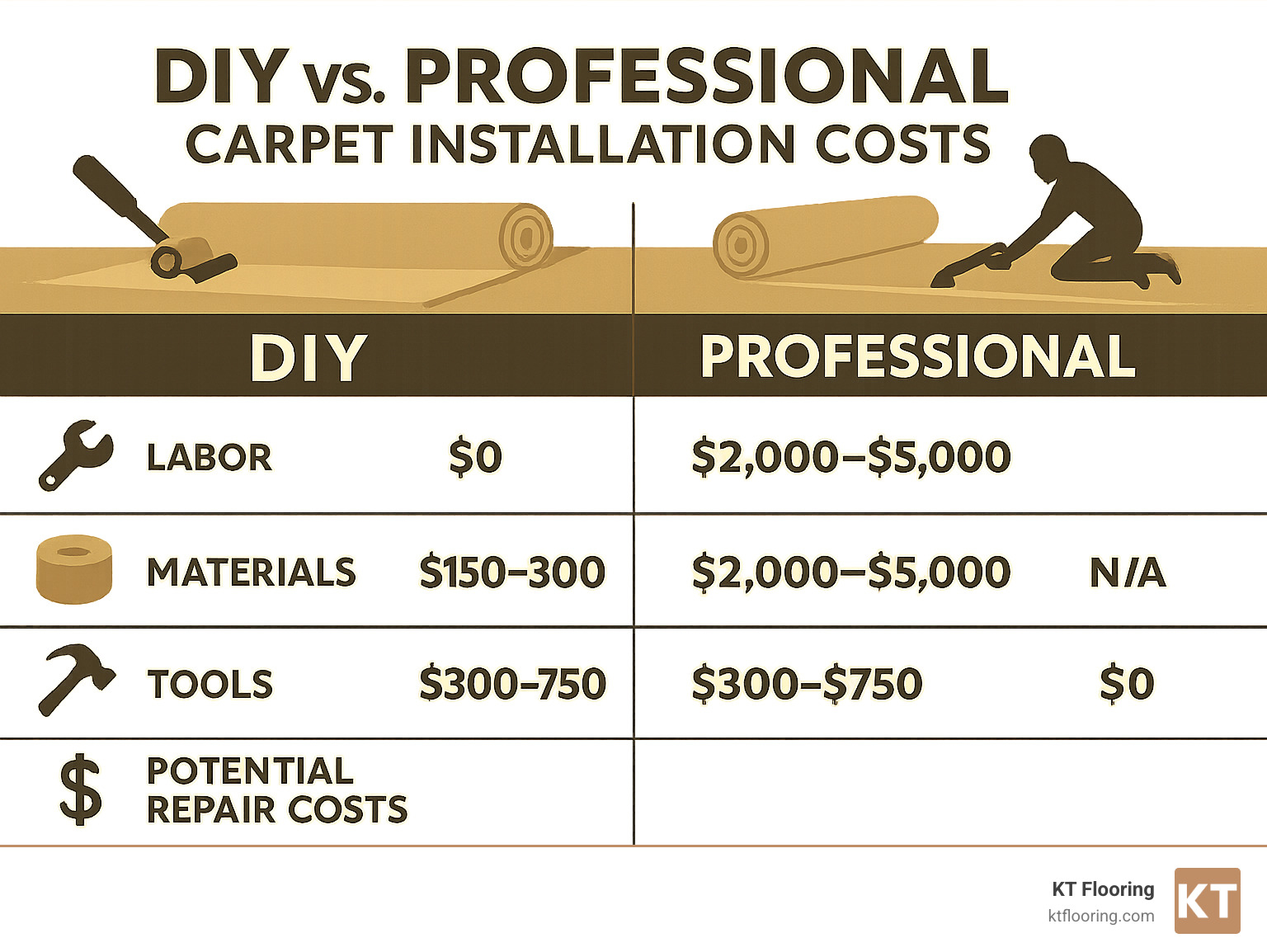
DIY Approach (1,000 sq ft)
* Materials: $2,000-$5,000
* Tools/supplies: $150-$300
* Waste factor (extra 5%): $100-$250
* Your time: 2-4 days
* Potential re-stretching later: $300-$750
* Total DIY Cost: $2,550-$6,300 (plus your time)
Professional Approach (1,000 sq ft)
* Materials: $2,000-$5,000
* Installation labor: $500-$1,500
* Removal/disposal: $700-$1,600
* Furniture moving: $100-$300
* Total Professional Cost: $3,300-$8,400
The apparent savings of $750-$2,100 must be weighed against:
* Your time value (typically 16-32 hours)
* Potential for mistakes requiring professional correction
* Warranty considerations
* Quality of finished installation
* Physical demands and potential injury
For most homeowners, the value of professional installation becomes clear when considering the complete picture. However, those with previous carpeting experience and access to proper tools might successfully tackle smaller, simpler rooms.
Money-Saving Strategies Without Cutting Corners
Whether you choose DIY or professional installation, there are several legitimate ways to reduce the average cost of carpeting a house without compromising quality:
Timing Your Purchase
* Shop during January-February or August-September (industry slow seasons)
* Look for year-end inventory clearance sales
* Ask about remnants for smaller rooms (10-40% savings)
Material Selection Strategies
* Consider last year’s styles (often discounted 15-30%)
* Choose standard colors rather than custom dyes
* Select in-stock materials to avoid special order premiums
* Consider polyester for bedrooms and less-trafficked areas
Installation Savings
* Remove old carpet yourself (saves $0.25-$0.50 per sq ft)
* Move furniture before installers arrive (saves $25-$75 per room)
* Reuse tack strips if they’re in good condition
* Schedule multiple rooms simultaneously to reduce trip charges
Shopping Smart
* Get at least three estimates from reputable companies
* Ask about remnant inventory for smaller rooms
* Inquire about package deals when carpeting multiple rooms
* Pay by cash or check to avoid credit card processing fees (often 2-3%)
Maintenance for Longevity
* Invest in professional cleaning every 12-18 months
* Use quality carpet padding to extend carpet life
* Place walk-off mats at entrances to reduce dirt and wear
At KT Flooring, we’re committed to helping you find the best value for your budget. Our free in-home consultations help identify opportunities for savings without sacrificing quality. Request an estimate to learn how we can help you maximize your flooring investment.
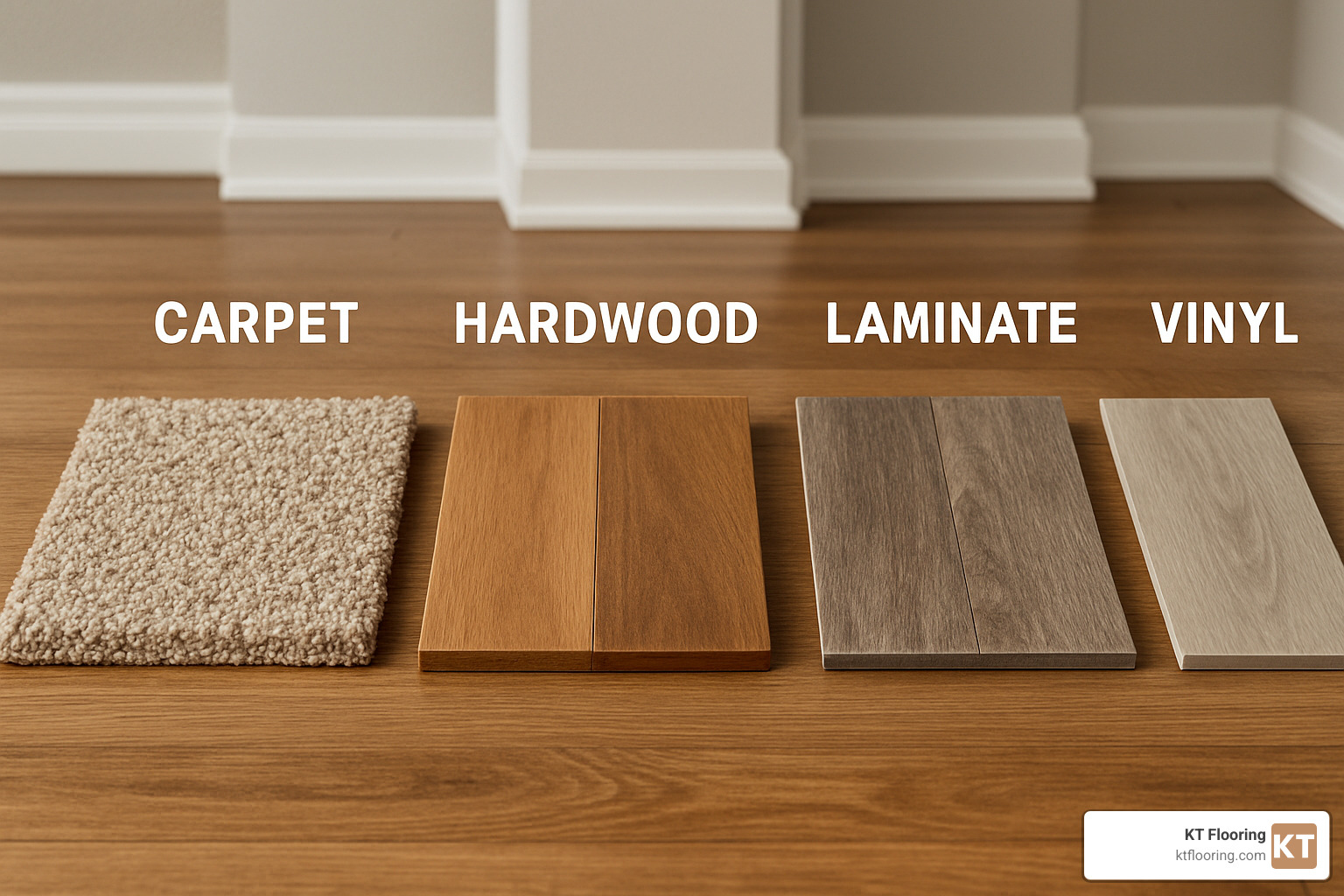
Comparing Carpet to Other Flooring Options
When evaluating the average cost of carpeting a house, it’s helpful to compare it with other popular flooring options to understand the relative value:
| Flooring Type | Material Cost | Installation | Total Installed | Lifespan |
|---|---|---|---|---|
| Carpet | $1-$21/sq ft | $0.50-$1.50/sq ft | $2-$8/sq ft | 5-20 years |
| Laminate | $1-$5/sq ft | $2-$4/sq ft | $3-$9/sq ft | 15-25 years |
| Luxury Vinyl | $2-$7/sq ft | $1.50-$3/sq ft | $3.50-$10/sq ft | 10-25 years |
| Engineered Hardwood | $3-$15/sq ft | $3-$5/sq ft | $6-$20/sq ft | 20-40 years |
| Solid Hardwood | $5-$20/sq ft | $4-$8/sq ft | $9-$28/sq ft | 30-100+ years |
| Ceramic Tile | $2-$15/sq ft | $5-$10/sq ft | $7-$25/sq ft | 50+ years |
Carpet Advantages
* Warmth and comfort underfoot
* Sound absorption (reduces noise by up to 70%)
* Lower initial cost than many hard surfaces
* Easier and less expensive to install
* Provides insulation (can reduce energy costs by 5-10%)
* Safer for young children and elderly (cushions falls)
Carpet Disadvantages
* Shorter lifespan than hard surfaces
* Requires more frequent maintenance
* Can trap allergens (though modern options mitigate this)
* More susceptible to staining and damage
* May need to be replaced more frequently
Each flooring type serves different needs and preferences. Many of our clients at KT Flooring opt for a mixed approach—using carpet in bedrooms and living areas while choosing hard surfaces for kitchens, bathrooms, and entryways.
Short-Term vs Long-Term Value for the average cost of carpeting a house
When evaluating the true cost of carpet, it’s important to consider both short-term investment and long-term value:
Initial Investment Considerations
* Carpet typically has a lower upfront cost than hardwood, tile, or stone
* Installation is generally faster and less disruptive
* Less expensive to replace in sections if damaged
Long-Term Value Factors
* Premium carpet (12-20 year lifespan) may need replacement 2-3 times during the life of hardwood flooring
* Energy savings from carpet insulation can offset 5-10% of heating costs
* Proper maintenance extends carpet life significantly:
* Professional cleaning ($0.25-$0.50 per sq ft annually)
* Vacuum high-traffic areas 2-3 times weekly
* Prompt stain treatment
Health and Comfort Value
* Modern hypoallergenic carpets can actually trap allergens until vacuumed (removing them from breathing zone)
* Carpet provides thermal comfort that hard surfaces cannot
* Sound absorption creates a quieter, more peaceful environment
* Reduced fatigue from standing compared to hard surfaces
Resale Value Impact
* Well-maintained, newer carpet can increase home value by 1-5%
* Dated or worn carpet can decrease value by 1-5%
* Neutral colors and mid-grade or better quality maximize return
For many homeowners in New Hampshire and Massachusetts, carpet remains the preferred choice for bedrooms and living spaces due to our cold winters. The comfort and warmth benefits are particularly valuable in our climate. Learn more about our regional expertise at carpet flooring solutions in Manchester NH.
Frequently Asked Questions about Carpet Costs
How long does carpet installation take?
When clients ask me about timing, I tell them that professional carpet installation is surprisingly efficient. For a typical home, we usually complete the job in 1-2 days. A standard bedroom (about 10×12) takes our experienced teams just 4-8 hours from start to finish.
Of course, every home is unique. If you’re carpeting an entire house or have intricate stairs, it might take longer. During your consultation with KT Flooring, we’ll assess your specific situation and provide a realistic timeline custom to your home’s needs.
Several factors can extend the installation timeline: extensive furniture moving (especially heavy pieces like pianos or china cabinets), removing old flooring, complex room layouts that require more seaming, staircase installation (which is precision work), or finding subfloor issues that need addressing before laying new carpet.
The good news? Professional installation is significantly faster than DIY approaches, getting your home back to normal quickly with minimal disruption to your daily life.
Are eco-friendly or hypoallergenic carpets more expensive?
Yes, eco-friendly and hypoallergenic options do typically cost more – usually about 10-30% above standard carpet prices. But many of our clients find this premium well worth the investment, especially families with allergy sufferers or those committed to environmental sustainability.
Natural fiber options like wool ($3-$21+ per sq ft) offer exceptional durability and are completely renewable. Plant-based options like sisal, jute, and seagrass ($4-$15 per sq ft) bring unique textures and sustainable credentials to your home. For a middle-ground approach, recycled polyester carpets made from plastic bottles ($2-$5 per sq ft) offer eco-friendly benefits at a more moderate price point.
The health benefits can be substantial. Modern hypoallergenic carpets trap dust and allergens (keeping them out of the air you breathe until vacuuming), while low-VOC options minimize chemical off-gassing that can irritate sensitive individuals. For homes with asthma sufferers or young children, these benefits often outweigh the additional cost.
I’ve seen how these specialty carpets can transform homes for allergy sufferers – sometimes allowing them to have soft flooring for the first time in years without triggering symptoms.
What warranties or guarantees should I expect?
Quality carpet isn’t just about what you feel underfoot today – it’s about how it performs for years to come. That’s where warranties become important.
Most quality carpets come with a suite of manufacturer warranties. You’ll typically see wear warranties ranging from 5-25 years depending on the grade of carpet. Stain resistance coverage generally matches this timeframe. Texture retention warranties (how well the carpet maintains its appearance) typically run 5-20 years, while color fade protection usually extends 5-15 years. Manufacturing defect coverage is generally shorter, often 1-10 years.
Just as important is the installation warranty. At KT Flooring, we stand confidently behind our craftsmanship with a comprehensive workmanship guarantee. This typically covers issues like seam integrity (1-5 years) and stretching/buckling problems.
Be aware that most warranties come with reasonable conditions. Professional installation is almost always required (DIY typically voids manufacturer coverage). Many also require professional cleaning every 12-18 months to remain valid. I always advise clients to keep their receipts and warranty documentation in a safe place, and to understand exactly what might void their coverage – like using the wrong cleaning products or failing to address pet accidents promptly.
These warranty terms reflect industry averages based on internet research, not specific KT Flooring warranty terms. During your consultation, we’ll explain exactly what protection comes with your specific carpet selection, ensuring you understand the long-term value of your investment.
Conclusion
Understanding the average cost of carpeting a house involves more than just a simple price per square foot. It’s a bit like planning a road trip – the final cost depends on the vehicle you choose, the route you take, and the extras you bring along for the journey.
While the national average ranges from $2 to $8 per square foot installed, premium options can reach $12-$24 per square foot for those seeking the highest quality materials and installation. For most homeowners in New Hampshire and Massachusetts, a mid-grade carpet with quality padding offers the sweet spot of comfort, durability, and value – much like choosing a reliable mid-size car for your family rather than a budget compact or luxury sedan.
At KT Flooring, we’ve been guiding homeowners through flooring decisions for over five decades. We’ve seen trends come and go, but our commitment to understanding your specific needs, lifestyle, and budget has remained constant. When you invite us into your home for a consultation, we’re not just measuring rooms – we’re learning about how you live, what matters to you, and how we can help create a space that feels just right underfoot.
The carpet you choose is an investment in your home’s comfort, appearance, and value. It’s the surface your children might learn to crawl on, where you’ll walk barefoot on chilly New England mornings, and what will greet your guests when they enter your living spaces. By weighing both immediate costs and long-term benefits, you can make a decision that serves your family beautifully for years to come.
Ready to explore your carpet options? Our free in-home consultations provide personalized guidance without pressure or obligation. Our experienced team proudly serves communities throughout New Hampshire and Northeast Massachusetts, including Manchester, Nashua, Hudson, Bedford, and surrounding areas.
For more information about our carpet products and services, visit our carpet flooring page or contact us to schedule your consultation today. We’d love to help you find the perfect balance of comfort and value for your home.