Why Solid Hardwood Floors Are the Smart Choice for New Hampshire Homes
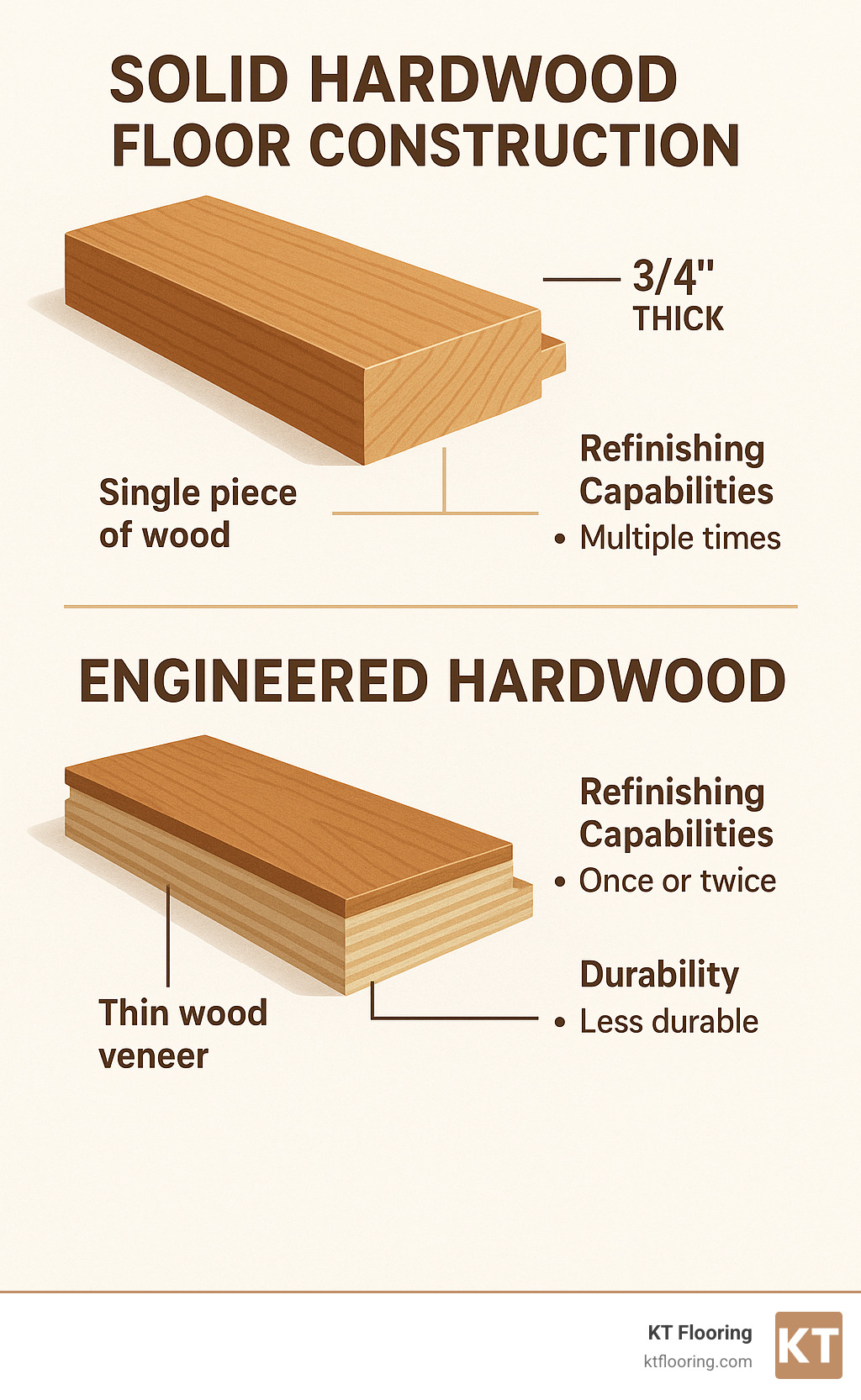
A solid hardwood floor is made from a single piece of wood throughout the entire plank, typically 3/4 inch thick, and can be sanded and refinished multiple times over its lifetime. Here are the key advantages:
Main Benefits:
– Lifetime durability – Can last as long as your house stands with proper care
– Multiple refinishing – Sand and refinish up to 10 times to restore like-new appearance
– Timeless beauty – Never goes out of style, showcases natural wood grain
– Home value boost – Increases resale value and buyer appeal
– Eco-friendly – Made from renewable resources, especially with FSC certification
Best Installation Areas:
– Living rooms, dining rooms, bedrooms, hallways
– Above-grade locations only (never basements)
– Kitchens with careful moisture management
When you step into a home with beautiful hardwood floors, it’s one of the first things you notice. As one flooring expert puts it: “Some flooring options are trendy — they come and go. But not wood flooring, and particularly solid hardwood flooring.”
I’m Christopher Talty, owner of KT Flooring, and I’ve been helping New Hampshire homeowners choose the perfect solid hardwood floor solutions for their homes since taking over our family business that started in 1974. With over 50 years of combined experience in flooring installation and refinishing, I understand exactly what makes solid hardwood such a smart long-term investment for your home.
Important solid hardwood floor terms:
– Best laminate flooring brands
– Best flooring for allergies
– Non-slip bathroom flooring
Solid Hardwood Floor Basics
What Is a Solid Hardwood Floor?
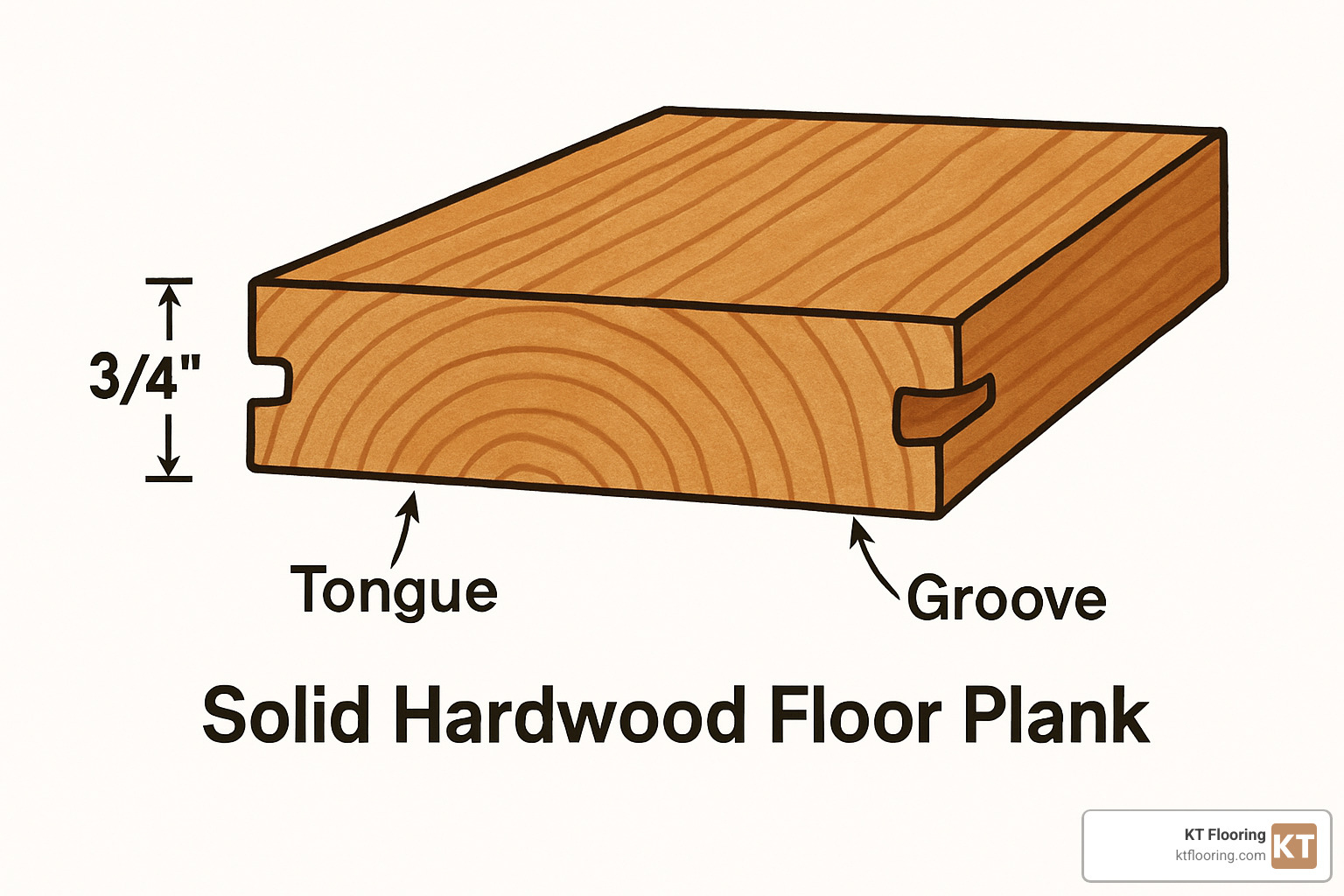
A solid hardwood floor is exactly what it sounds like – a plank cut straight from a tree, dried, and shaped into flooring. Every bit of that plank is genuine hardwood from the same tree species, with no hidden layers or composite materials.
Most solid hardwood floors come in the standard 3/4 inch thickness, though you’ll occasionally see 5/16 inch options. Each plank features tongue-and-groove construction that fits together like puzzle pieces during installation, creating a smooth, continuous surface while allowing the wood to move naturally with New Hampshire’s changing seasons.
Before installation, planks go through kiln-drying to remove excess moisture and prevent warping. You’ll find solid hardwood floors available in both strip (narrow planks typically 2.25 inches wide) and plank (wider boards up to 5 inches or more) styles.
How Is It Different from Engineered Hardwood?
While a solid hardwood floor is wood through and through, engineered hardwood is like a sandwich – a thin slice of real wood on top of a multi-ply core made from plywood or other materials.
Engineered flooring wins on moisture stability and can handle basement installations. But when it comes to resale value and longevity, solid hardwood takes the crown.
| Feature | Solid Hardwood Floor | Engineered Hardwood |
|---|---|---|
| Construction | Single piece of wood | Wood veneer over plywood core |
| Thickness | Typically 3/4″ | Usually 1/2″ to 5/8″ |
| Refinishing | Up to 10 times | 1-3 times maximum |
| Moisture Stability | Moderate | Higher |
| Installation | Above-grade only | Any level including basements |
| Resale Value | Highest | Good |
| Lifespan | 50+ years | 20-30 years |
The refinishing difference is huge. With solid hardwood’s full 3/4 inch thickness, you can sand it down and refinish it up to 10 times over its lifetime. Engineered floors, with their thin top layer, give you maybe 2-3 refinishing opportunities before you hit the core.
Advantages of Choosing a Solid Hardwood Floor
When homeowners ask me why they should invest in a solid hardwood floor, I always start with the same truth: it’s one of the few home improvements that literally gets better with age.
Lifetime durability is where solid hardwood truly sets itself apart. I’ve refinished floors in New Hampshire homes that were installed over 80 years ago, and they’re still going strong. The thick 3/4-inch construction means these floors can handle whatever life throws at them.
The real magic happens with multiple refinishing opportunities. While other flooring types show their age and need complete replacement, your solid hardwood floor can be sanded down and refinished up to 10 times throughout its lifetime. Each refinishing is like hitting a reset button – scratches disappear, and you can even change the stain color completely.
The aesthetic versatility solid hardwood offers is remarkable. The natural grain patterns create character that’s impossible to fake. Oak’s prominent grain naturally hides everyday scratches, making it perfect for busy families. Maple’s subtle, clean grain works beautifully in modern homes.
For families dealing with allergies, solid hardwood creates an allergy-friendly environment that carpet simply can’t match. There’s nowhere for dust mites, pet dander, or pollen to hide.
The acoustic comfort surprises many homeowners. Solid wood naturally dampens sound, reducing that hollow feeling you get with some other flooring types.
Here’s something every homeowner should know: solid hardwood floors provide a significant value boost. Real estate agents tell me it’s one of the first things potential buyers notice. Quality hardwood floors don’t just increase your home’s value – they make it sell faster too.
For detailed cost analysis and budgeting information, check out our comprehensive solid wood flooring cost guide.
Selecting Species, Finishes, and Dimensions
Choosing your perfect solid hardwood floor involves three main decisions: which wood species speaks to you, whether to go with unfinished or prefinished planks, and what size planks work best in your space.
Popular Domestic Species
Red oak remains America’s sweetheart when it comes to hardwood flooring. Its prominent grain patterns naturally hide everyday scratches that come with family life. With a Janka hardness rating of 1,290, it handles foot traffic beautifully while staying budget-friendly. Plus, red oak loves stain, giving you endless color possibilities.
White oak steps things up with its 1,360 Janka rating and tighter grain patterns that create a more refined look. Its closed-cell structure gives it natural water resistance, making it smart for kitchens.
Maple brings a clean, contemporary vibe with its light, creamy tones and subtle grain. At 1,450 on the Janka scale, it’s tough enough for busy households.
Hickory is the tough guy of domestic hardwoods, scoring 1,820 on the Janka scale. Its bold grain patterns and natural color variations make each plank unique, perfect for rustic or country-style charm.
Walnut is the luxury option with rich chocolate tones and sophisticated grain patterns. While softer at 1,010 Janka rating, walnut works beautifully in dining rooms and bedrooms where you want maximum visual impact.
Our team loves helping clients explore samples from various Hardwood Flooring Manufacturers to find that perfect species.
Finish Options: Unfinished vs Prefinished Solid Hardwood Floor
Unfinished solid hardwood floors arrive looking like raw wood, ready for our craftsmen to sand and apply finish right in your home. You get complete control over the final look and can match existing trim perfectly. The site-finishing process also seals gaps between planks, creating that smooth, uniform appearance.
Prefinished solid hardwood floors come ready to walk on, with multiple coats of factory-applied finish cured under controlled conditions. These aluminum-oxide finishes are incredibly tough and you can move furniture back immediately after installation. The trade-off is limited color selections and subtle beveled edges between planks.
Plank Width, Thickness, and Grade Choices
Plank width dramatically affects how your room feels. Narrow strip planks under 3 inches give you that classic, traditional look and can make smaller rooms appear larger. Standard width planks between 3-4 inches work in any room size and complement both traditional and contemporary styles. Wide plank flooring at 5-7 inches creates a bold, modern statement.
For thickness, most residential solid hardwood floors come in 3/4 inch, giving you maximum refinishing potential over the decades.
Grade choices let you decide how much natural character you want. Select grade gives you clean, uniform appearance with minimal knots. Common or rustic grade accepts nature’s personality with knots and color variations that make each plank unique.
Installation, Room Suitability & Climate
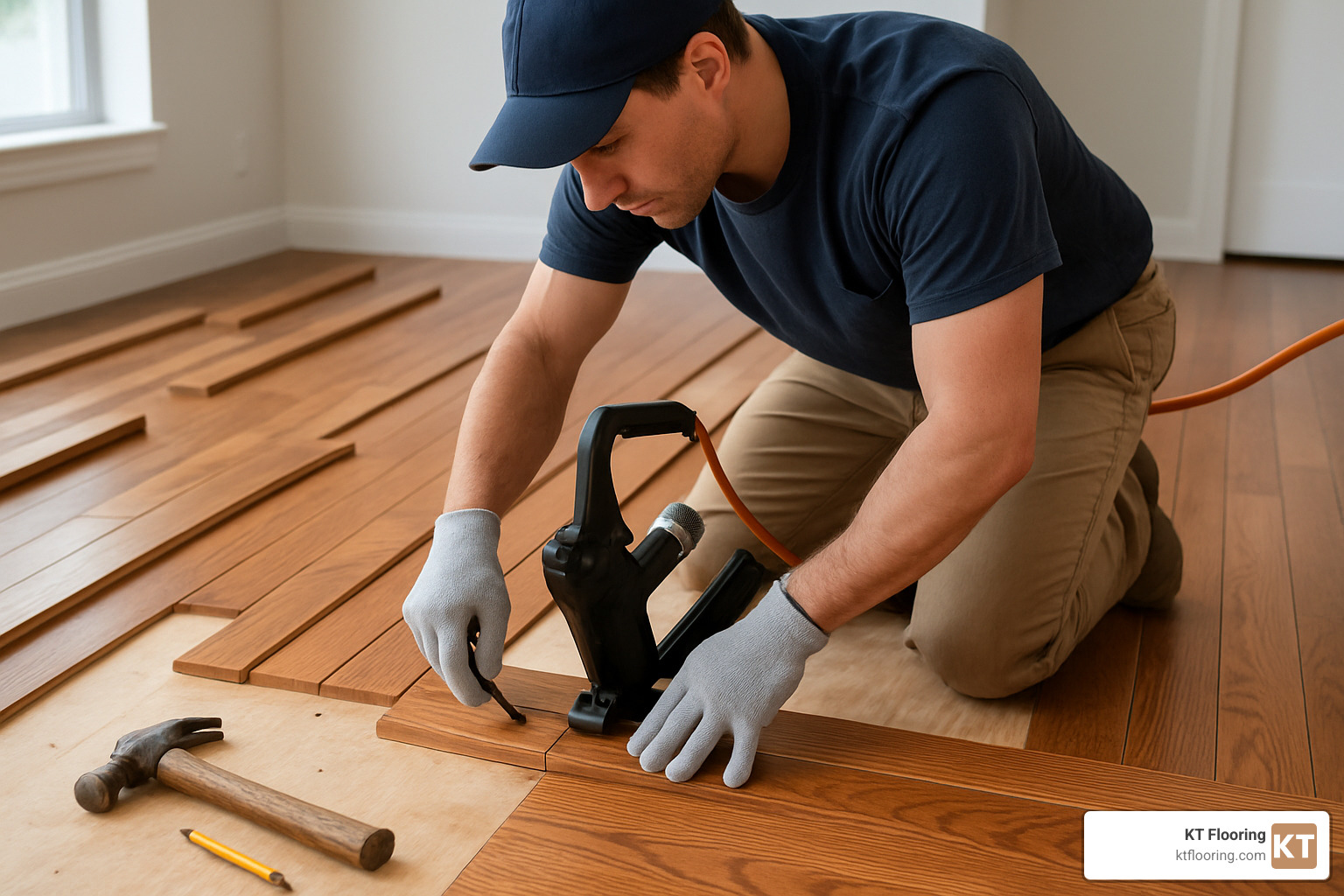
Installing a solid hardwood floor requires understanding how this living material responds to your home’s environment. Nail-down installation is the gold standard for 3/4-inch solid hardwood over plywood subfloors. Staple installation works similarly but often speeds up the process. For concrete subfloors, glue-down installation becomes necessary for thinner planks.
Your new solid hardwood floor needs time to get comfortable in your home before installation begins. The acclimation process requires the wood to sit in your home for 3-7 days, adjusting to your specific temperature and humidity levels.
One non-negotiable rule: above-grade only installation. Never install solid hardwood in basements or any area below ground level due to moisture risks.
Our professional Hardwood Floor Installation Services handle all these details, ensuring proper acclimation and installation. We also specialize in Environmentally Friendly Hardwood Flooring options.
Where in the Home Can a Solid Hardwood Floor Shine?
Living rooms are where solid hardwood floors truly come alive. The durability of 3/4-inch solid planks handles all that foot traffic while creating a warm, welcoming atmosphere.
Dining areas showcase solid hardwood’s natural beauty like nowhere else. The formal elegance makes every meal feel special.
Bedrooms benefit from the natural comfort and warmth that solid hardwood provides underfoot, plus the natural insulation properties help maintain comfortable temperatures.
Hallways are perfect for solid hardwood since these high-traffic corridors get the most wear, making the refinishing potential especially valuable.
Kitchens are possible with careful moisture management, requiring extra attention to spill cleanup and humidity control.
Avoid full bathrooms, laundry rooms, and basements – anywhere moisture is a constant concern.
Managing Moisture and Seasonal Movement
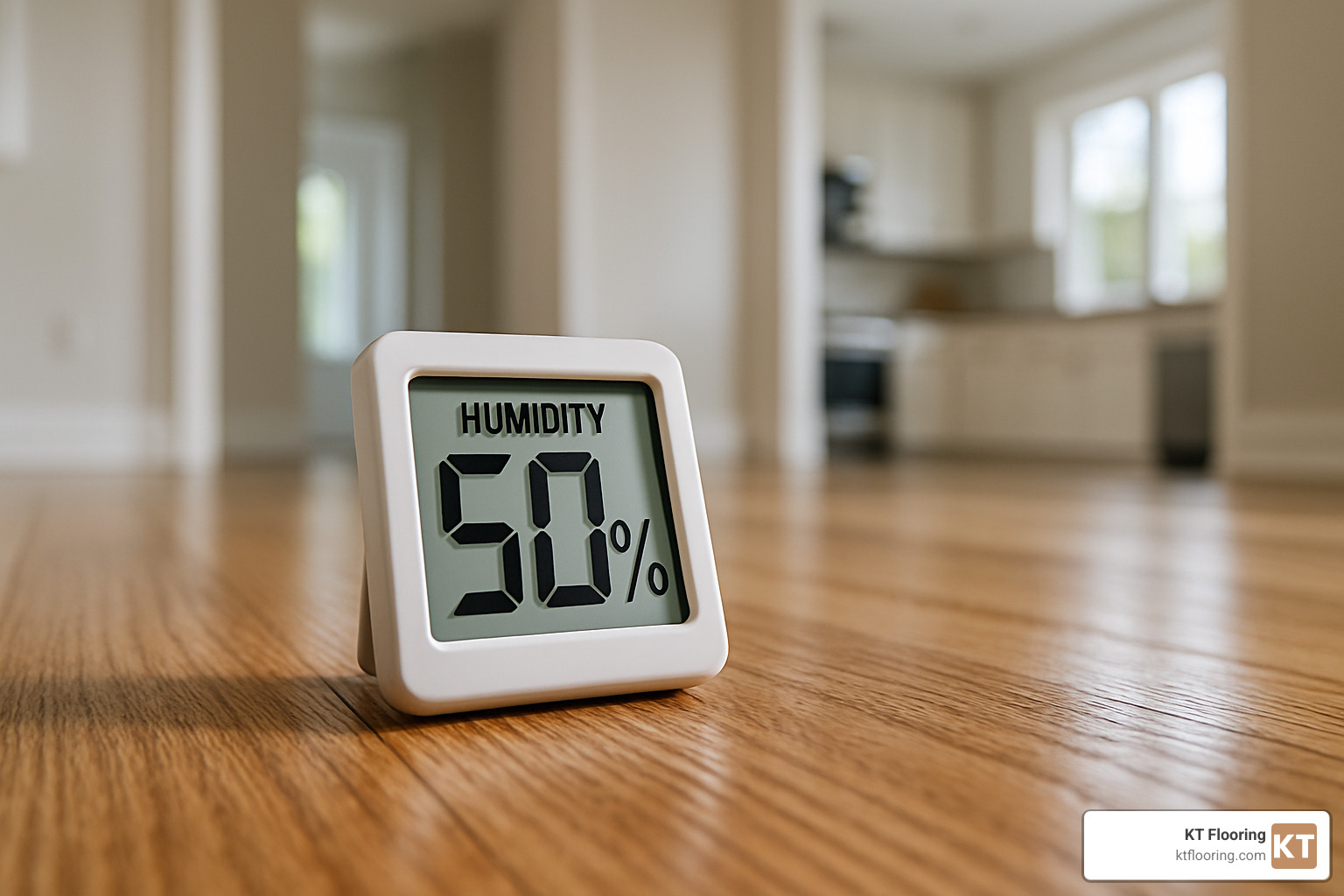
Maintaining humidity levels between 30-50% is essential for preventing problems. During New Hampshire’s dry winter months, heating systems can drop indoor humidity dramatically, causing gapping as wood contracts. This is normal seasonal behavior that typically resolves in spring.
Cupping happens when plank bottoms absorb more moisture than tops, causing edges to curl upward. Crowning is the opposite – when plank centers rise higher than edges.
A hygrometer becomes your best friend for tracking humidity levels. Running humidifiers in winter prevents excessive drying, while using dehumidifiers in summer controls excess moisture. Address any plumbing leaks immediately – water is solid hardwood’s biggest enemy.
Some seasonal movement is completely normal and expected. Minor winter gapping that closes up in summer is just your solid hardwood floor adapting to its environment while providing decades of beauty.
Care, Maintenance & Refinishing Lifespan
Taking care of your solid hardwood floor is surprisingly simple once you know the basics, and the reward is floors that look stunning for decades.
Cleaning Routine for a Solid Hardwood Floor
Daily routine: gentle sweep with a soft-bristled broom, moving with the wood grain. A dust mop or microfiber cloth picks up fine particles a broom might miss.
When spills happen, clean them immediately with a damp cloth, moving with the grain. Water is wood’s biggest enemy, so quick action prevents damage.
Weekly cleaning: vacuum with hard floor setting (never carpet beater bars), then follow with a barely damp mop using pH-neutral hardwood floor cleaner. Your mop should be wrung out so well it’s almost dry.
Never do: Steam cleaning is off-limits – moisture and heat cause permanent damage. Skip harsh chemicals, abrasive cleaners, and wax-based products with polyurethane finishes. Wipe up standing water immediately.
Protection strategies: Felt pads under furniture legs prevent scratches. Mats at entrances catch dirt and moisture. Keep pet nails trimmed and consider area rugs in high-traffic zones.
When and How Often Should You Refinish?
A standard 3/4-inch solid hardwood floor can handle up to 10 complete refinishing cycles, meaning decades of like-new beauty.
You’ll know it’s time when surface scratches can’t be buffed out, when the protective finish looks worn, or when you want a color change.
Refinishing frequency depends on traffic. High-traffic areas need attention every 7-10 years. Moderate traffic areas can go 10-15 years, while low-traffic spaces might not need refinishing for 15-25 years.
Each refinishing removes approximately 1/32 inch of wood surface, creating a fresh canvas for new stain colors and finishes.
Our experienced Hardwood Floor Refinishing Services team helps New Hampshire homeowners restore floors to showroom condition and explore new color possibilities.
Costs, ROI & Eco Considerations
While a solid hardwood floor is an investment, it’s one that pays you back in both daily enjoyment and long-term value.
Average Price Ranges (Not KT Flooring Quotes)
These are average costs based on internet data and not actual costs for KT Flooring products and services.
Material costs vary dramatically based on species and processing. Softwood species like pine start around $3 per square foot but can reach $18 for premium grades. Domestic hardwood species such as oak and maple typically range from $5 to $30 per square foot. Exotic hardwood options begin around $8 per square foot but can soar to $60 or more for rare species.
Installation costs depend on your home’s conditions. Basic nail-down installation runs $3 to $24 per square foot. Complex projects can cost $8 to $30+ per square foot.
Extras add up: Subfloor preparation ranges from $1 to $8 per square foot. Furniture removal adds $0.20 to $2 per square foot. Trim and molding costs $2 to $15 per linear foot. On-site finishing adds $1 to $6 per square foot.
For a typical 400 square foot living room, total project costs range from $2,400 to $24,000, with luxury installations reaching higher.
The good news: solid hardwood floors consistently deliver 70-80% return on investment. When you factor in the 50+ year lifespan and multiple refinishing opportunities, solid hardwood becomes one of the most cost-effective flooring choices.
For project-specific pricing, check out our Hardwood Flooring Installation Cost guide.
Environmental Certifications & Responsible Sourcing
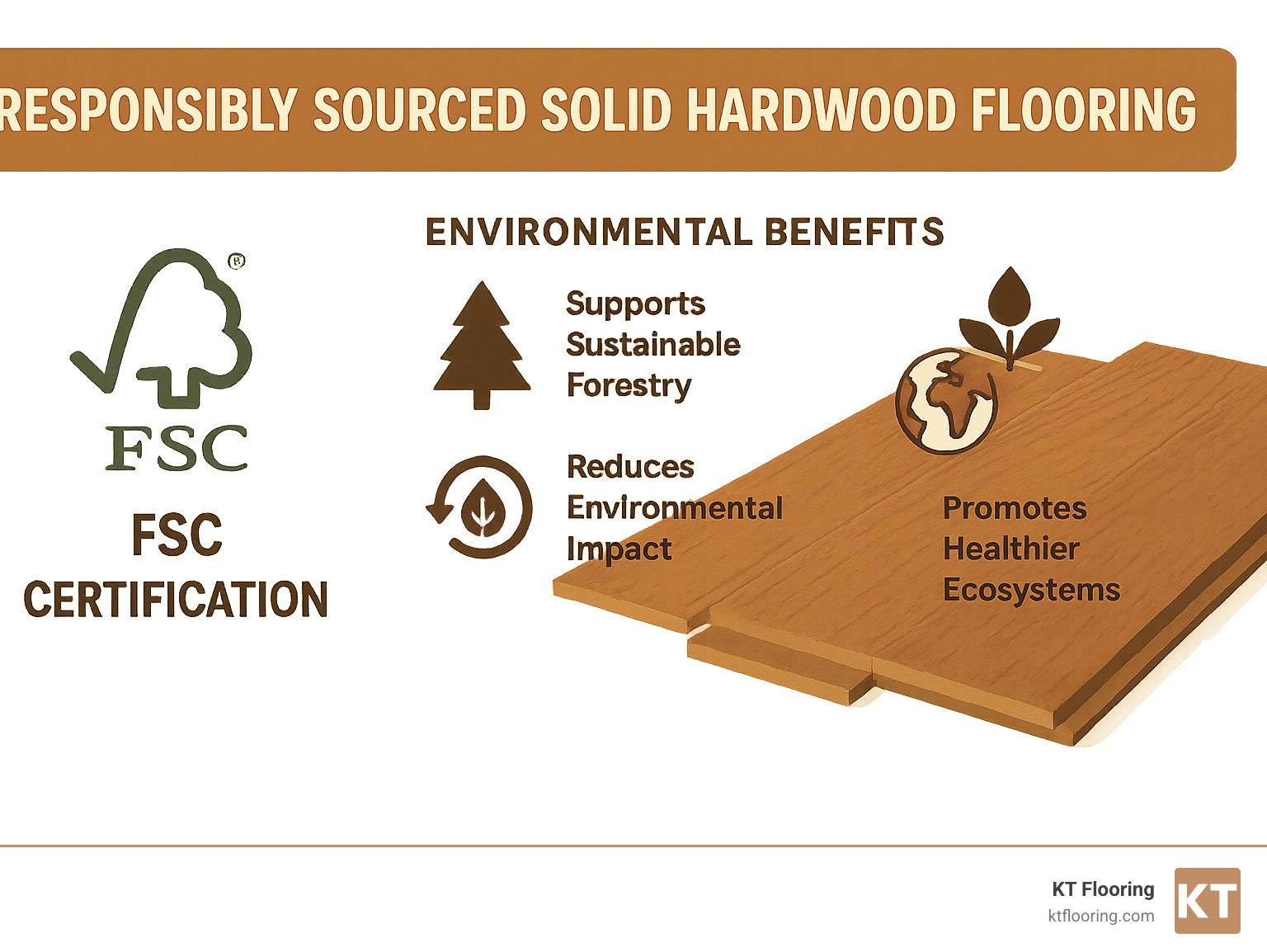
FSC certification ensures your flooring comes from forests managed for long-term environmental health, wildlife protection, and fair treatment of workers. CARB II compliance protects indoor air quality by limiting formaldehyde emissions.
Regional sourcing offers environmental benefits. Appalachian hardwoods are prized for stability and consistent grain patterns. Reclaimed lumber offers unique character from old barns and buildings while giving beautiful wood a second life.
Solid hardwood’s sustainability advantages are compelling. Wood naturally sequesters carbon throughout its lifetime. Since solid hardwood can last 50+ years with multiple refinishing cycles, you’re reducing long-term environmental impact compared to flooring needing replacement every decade.
As forests are replanted and managed responsibly, wood remains our most renewable building material.
Frequently Asked Questions about Solid Hardwood Floors
Over the years, I’ve answered countless questions about solid hardwood floor installation and care. Here are the most common concerns homeowners share during our consultations.
Can I install a solid hardwood floor in my kitchen or basement?
The kitchen question comes up in almost every home consultation, and I understand why. You want that beautiful wood flow throughout your main living areas, and honestly, it can work beautifully in kitchens with the right approach.
Kitchen installations are absolutely possible with solid hardwood floors, but they do require extra attention. I always recommend choosing harder species like white oak, which has natural moisture resistance thanks to its closed-cell structure. The key is maintaining good ventilation and being diligent about spill cleanup – no letting that morning coffee sit while you rush off to work!
Many of our clients have gorgeous solid hardwood in their kitchens that’s held up beautifully for decades. The secret is treating it with a bit more care than you would in a living room.
Basements are a completely different story. I never recommend solid hardwood floors below grade, and I’m pretty firm about this one. The moisture risk is just too high, even in seemingly dry basements. I’ve seen too many beautiful floors ruined by humidity issues, warping, and even mold problems.
If you’re dreaming of wood floors in your finished basement, engineered hardwood is your friend. It gives you that wood look with much better moisture stability.
How many times can a solid hardwood floor be refinished?
This is where solid hardwood floors really shine compared to other flooring options. A standard 3/4-inch solid hardwood plank can typically handle 8-10 refinishing cycles throughout its lifetime. That’s potentially 100+ years of beautiful floors!
Each time we refinish, we remove about 1/32 inch of wood surface. It doesn’t sound like much, but it’s enough to erase decades of wear and even change the color completely if you want a fresh look.
The exact number depends on several factors. If your floors have deep scratches or pet damage, we might need to sand deeper, which uses up more of that precious wood thickness. The skill of your refinishing professional matters too – experienced craftsmen can often work with thinner remaining wood than less experienced workers.
Thinner solid hardwood at 5/16 inch obviously has less refinishing potential – usually just 1-2 cycles. This is one reason why we typically recommend the standard 3/4-inch thickness for most installations.
What plank width looks best in small rooms?
I get this question a lot, especially from homeowners with cozy New England homes. The traditional advice is that narrow planks (less than 3 inches wide) can make small rooms appear larger by creating more visual lines that lead the eye along the length of the room.
There’s some truth to this, but honestly, the effect is pretty subtle. I’ve installed narrow strip flooring in small rooms that looked great, and I’ve also done wide plank solid hardwood floors in compact spaces that were absolutely stunning.
Standard 3-4 inch planks are the most versatile choice and work beautifully in any room size. They’re also the most readily available, which can help with both cost and future repairs.
Wide planks (5+ inches) really showcase the natural wood grain and can create a more contemporary, open feel. In a small room, they might make the space feel more intimate rather than cramped – it really depends on your overall design goals.
My advice? Bring home some samples and live with them for a few days. Look at them in different lighting conditions and see what feels right to you. After all, you’re the one who’ll be walking on them every day, and personal preference trumps design rules every time.
Conclusion
When you’re ready to transform your home with flooring that will last a lifetime, a solid hardwood floor stands as the clear winner. What other home improvement can you sand down and make look brand new again up to 10 times over the decades?
The math is simple: lifetime durability, multiple refinishing opportunities, timeless beauty, and significant home value boost all add up to one smart investment. While you might pay more upfront, when you spread that cost over 50+ years of enjoyment, solid hardwood becomes one of the most economical choices you can make.
Here at KT Flooring, we’ve watched families fall in love with their solid hardwood floors for over 50 years. From our Hudson, NH location, we’ve installed solid hardwood in homes throughout Southern New Hampshire and Northeast Massachusetts—from cozy cottages in Nashua to neat colonials in Concord, busy family homes in Manchester to historic properties in Lowell and Lawrence.
What sets us apart? Our free in-home consultations let us understand your lifestyle, your home’s characteristics, and your vision. We’re not just selling flooring—we’re helping you create the foundation for decades of memories.
Whether you’re dreaming of rich walnut in your dining room, classic white oak throughout your main level, or durable hickory in your family room, we’ll guide you through every decision. From species selection to finish options, from installation to long-term care, we’re your partners in creating something beautiful that will last.
Ready to see why solid hardwood floors remain the gold standard? Give us a call and let’s schedule your free consultation. We’ll bring samples right to your home so you can see how different species and finishes look in your actual lighting.
Your dream floors are waiting—let’s make them a reality together. Visit our comprehensive Hardwood Flooring resource center to explore all your options and get started on your solid hardwood journey today.
