Finding Beauty on a Budget: The Truth About Affordable Tile
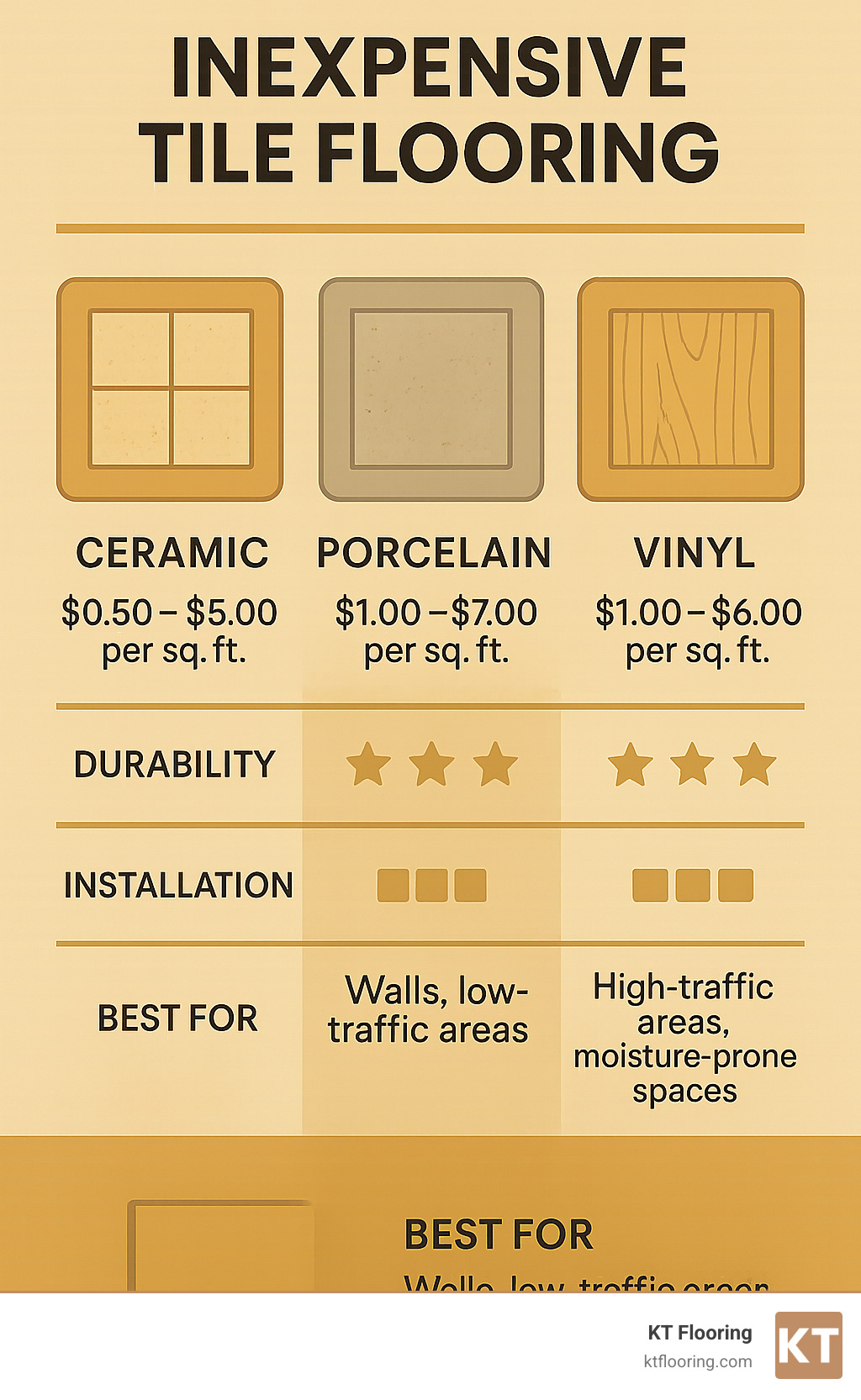
Looking for inexpensive tile flooring options that don’t sacrifice quality? Here’s a quick overview of the most affordable tile flooring choices:
| Tile Type | Average Cost Per Sq. Ft. | Durability | Best For |
|---|---|---|---|
| Ceramic | $0.89-$3.99 | Medium | Walls, low-traffic areas |
| Vinyl Tile | $1.39-$4.99 | High | Kitchens, bathrooms, basements |
| Porcelain | $2.79-$7.00 | Very High | High-traffic areas, moisture-prone spaces |
| Clearance/Overstock | $0.59-$2.99 | Varies | Any area (limited selection) |
Inexpensive tile flooring doesn’t mean you have to settle for boring designs or questionable quality. In fact, today’s budget-friendly options can transform your home beautifully without emptying your wallet. I’ve seen countless homeowners walk into our showroom worried about costs and leave amazed at what they can actually afford.
The secret to finding beautiful tile on a budget isn’t just about the price tag – it’s about understanding which materials give you the most bang for your buck, knowing where to hunt for deals, and deciding whether rolling up your sleeves for DIY installation makes sense for your situation.
Many of our customers are pleasantly surprised to find that stunning, durable tile flooring can be found for under $1 per square foot during sales and clearance events. These aren’t leftover odd lots nobody wanted – they’re often just discontinued styles or overstock items that retailers need to move.
I’m Christopher Talty, owner of KT Flooring, and over my decades in the business, I’ve helped thousands of New Hampshire and Massachusetts homeowners find quality inexpensive tile flooring solutions. My team takes pride in matching budget-conscious shoppers with flooring options that stand the test of time without breaking the bank.
If you’re exploring budget-friendly options, you might also want to check out our information on Best vinyl flooring prices and best deals for flooring.
Why Cost Counts in a Tile Project
Understanding the full financial picture of your tile project goes well beyond the price per square foot on the box. That sticker price is just the beginning of your budget story.
A typical tile project includes several cost components that many homeowners don’t initially consider. The material costs cover not just the tiles themselves, but also grout, adhesive, and underlayment. If you’re not handling the job yourself, installation labor can sometimes exceed the cost of materials. Then there are tools and supplies (especially for DIYers), delivery fees, and don’t forget the waste factor – you’ll need to purchase 10-15% extra material to account for cuts and breaks.
Many homeowners also overlook the cost of removing existing flooring, which can add significantly to the bottom line, especially if there are multiple layers to remove or if asbestos is present in older homes.
“I always tell customers to look beyond the tile price tag,” shares our installation manager at KT Flooring. “That $1.99 per square foot ceramic might seem like a bargain until you realize the complex pattern you want increases labor costs by 30%. Sometimes, spending a little more on easier-to-install tile actually saves money in the end.”
Hidden fees can quickly derail your budget. For instance, if your subfloor needs significant leveling (a common issue in older New England homes), you might need to add $2-5 per square foot to your budget. Similarly, intricate installation patterns like herringbone or basket weave can boost labor costs by 20-30% due to the additional cutting and precision required.
At KT Flooring, we believe in transparent pricing and helping customers understand the true cost of their project from the beginning – no surprises, just beautiful floors that fit your budget.
Understanding Inexpensive Tile Flooring Materials
Walking into a flooring showroom can feel overwhelming with all the options available. Trust me, I’ve seen the deer-in-headlights look on many customers’ faces! The good news? Finding inexpensive tile flooring doesn’t mean settling for something that’ll fall apart in a year. Let me guide you through the budget-friendly options we’ve been installing for New Hampshire families for decades.
“Inexpensive Tile Flooring” Basics
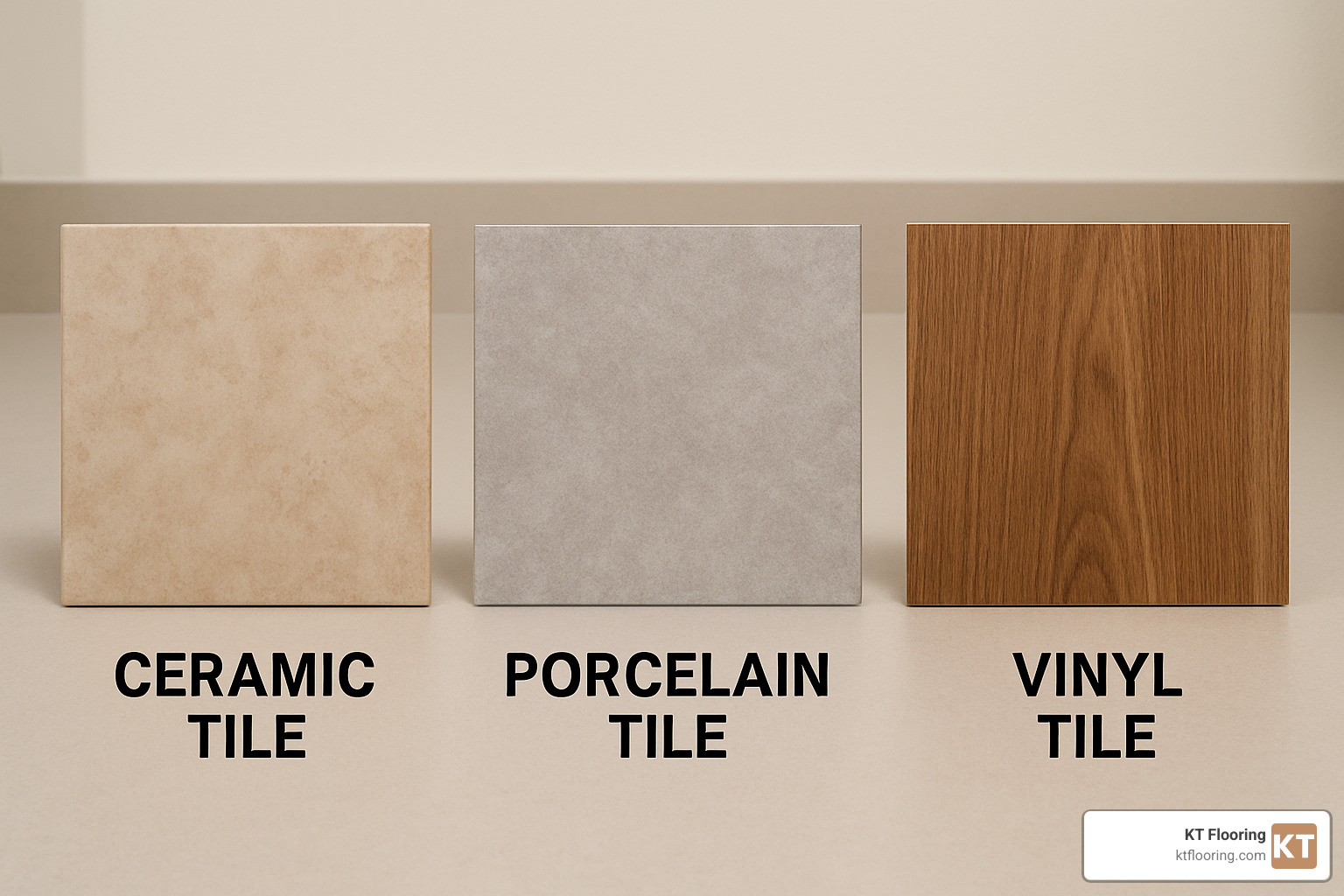
When we talk about affordable tile, we’re typically looking at three main categories, each with their own charm and practical benefits.
Ceramic tile is your friendly neighborhood classic. Made from clay that’s been fired in a kiln (but at lower temperatures than its porcelain cousin), ceramic offers an excellent balance of affordability and style. The surface is typically glazed, giving you endless color options while providing good stain resistance. At KT Flooring, we often recommend ceramic for walls, backsplashes, and rooms where foot traffic isn’t constantly pounding away. With proper care, these tiles can look beautiful for 15-20 years.
Porcelain tile is ceramic’s tougher sibling. The same clay material gets fired at much higher temperatures, creating a denser, harder surface that stands up beautifully to our harsh New England winters and busy family homes. While traditionally pricier, we’ve seen budget porcelain options starting around $2.79 per square foot that offer remarkable value. The density makes porcelain nearly waterproof without additional sealing, perfect for bathrooms and kitchens. With a potential lifespan of 20-50 years, it’s often the most economical choice in the long run.
Vinyl tile has come a long way from your grandmother’s kitchen floor! Today’s vinyl options use synthetic composites to create incredibly realistic stone and wood looks. Luxury vinyl tile (LVT) offers amazing durability with click-together installation that many homeowners can handle themselves. Vinyl composition tile (VCT) provides an even more budget-friendly option for basements and utility spaces. The water-resistance is practically bulletproof, making vinyl ideal for moisture-prone areas. Expect 10-20 years of service from quality vinyl tiles.
Comparing Ceramic vs. Porcelain vs. Vinyl
When helping customers choose inexpensive tile flooring, I always emphasize that the “cheapest” option isn’t always the most economical in the long run. Let’s break down how these materials compare:
| Feature | Ceramic | Porcelain | Vinyl Tile |
|---|---|---|---|
| Composition | Clay, fired at lower temps | Clay, fired at high temps | PVC, plasticizers, fiberglass |
| Hardness (Mohs scale) | 4-6 | 7-9 | Not applicable |
| Water Absorption | 0.5-3% | <0.5% | Virtually 0% |
| PEI Rating Range | 1-4 | 3-5 | Not rated (different scale) |
| DIY Installation | Moderate | Challenging | Easy |
| Typical Warranty | 1-5 years | 10-25 years | 5-20 years |
| Cost Range | $0.89-$10/sq ft | $2.79-$15/sq ft | $1.39-$7/sq ft |
One thing I always explain to customers is the PEI rating system. This scale from the Porcelain Enamel Institute helps you understand exactly where a tile should be used. A PEI 1 tile belongs only on walls, while a PEI 5 can handle a commercial kitchen. For most homes, aim for PEI 3 (normal residential traffic) or PEI 4 (heavy residential/light commercial) in busy areas.
“I installed porcelain tile in my own kitchen 18 years ago,” shares Mike, our senior installer at KT Flooring. “Three kids, two dogs, and countless holiday gatherings later, it still looks almost new. Even our budget-friendly porcelain options often outlive the homes they’re installed in.”
For DIY enthusiasts, vinyl tile offers the gentlest learning curve. Ceramic requires more skill but remains doable for motivated homeowners. Porcelain, while tougher to cut and install, rewards you with decades of virtually maintenance-free performance. At KT Flooring, we’re happy to discuss whether DIY makes sense for your particular project or if professional installation would better protect your investment.
When it comes to eco-friendly options, today’s market offers recycled glass mosaics and low-VOC vinyl tiles that are both gentle on your wallet and the environment. Some manufacturers even produce ceramic tiles using reclaimed clay, giving you affordable style with a clear conscience.
No matter which inexpensive tile flooring option catches your eye, our team at KT Flooring can help you steer the choices to find the perfect balance of price, performance, and style for your specific needs.
How to Balance Cost, Durability & Design
Finding that perfect balance between what you can afford and what will actually last isn’t just smart—it’s an art form. As a homeowner looking at inexpensive tile flooring, you need to think beyond today’s price tag and consider the full lifetime value of your investment.
Value per square foot is about playing the long game. That $3/sq ft porcelain tile that stays beautiful for 30 years? It’s actually a better deal than the $1/sq ft ceramic that needs replacing after just a decade. This is especially true in high-traffic zones like your busy kitchen or that entryway where everyone stomps in with muddy boots during New Hampshire winters.
Scratch resistance becomes your best friend if you have pets racing around the house or children dropping toys. Look for tiles with higher PEI ratings (4-5) for your floors, while saving a few dollars by using tiles with lower ratings on walls and in spaces that see less action.
“The most expensive mistake I see homeowners make is putting delicate tile in high-traffic areas,” says our lead installer at KT Flooring. “Within months, they’re noticing wear patterns that could have been avoided with the right material choice.”
Safety matters too, particularly in potentially slippery areas. Tiles with a coefficient of friction (COF) of at least 0.42 work well for standard floors, while bathrooms and kitchens benefit from a higher rating of 0.60+. The good news? Many budget-friendly options meet these standards without the premium pricing.
According to scientific research on floor wear rates, the right tile in the right location can last decades longer than inappropriate materials, regardless of initial cost. This research confirms what we’ve seen in thousands of New Hampshire homes over our 50+ years in business.
Your grout choice makes a surprising difference too. While epoxy grout costs more upfront, it resists staining and doesn’t need sealing, potentially saving both money and weekend maintenance projects over time compared to standard cement grout.
Size, Style & Finish Tricks for “Inexpensive Tile Flooring”
Want to know how designers create high-end looks without the high-end price tag? These insider tricks can help you achieve a luxury look on a modest budget:
Large format tiles (12×24 inches or larger) create an expansive, luxurious feel while requiring fewer grout lines. This not only looks more expensive but also means less time cleaning grout and faster installation. Watch for seasonal promotions when manufacturers discount these larger sizes.
Subway tiles remain one of the most affordable yet timeless options around, often available for under $1/sq ft during sales. For a modern twist that still keeps costs low, consider slightly larger 4×8 or 4×12 formats that offer a fresh take on this classic style.
Stone-look tiles have come a long way in recent years. Today’s ceramic or vinyl options can convincingly mimic expensive marble, travertine, or slate without the hefty price tag. The printing technology has become so advanced that even budget lines can fool all but the most discerning eyes.
Clearance colors offer perhaps the biggest potential savings. These aren’t defective tiles—they’re perfectly good options that simply aren’t trending at the moment. Neutral beiges, grays, and whites frequently hit the clearance racks as manufacturers update their lines, offering savings of 40-70% off regular prices.
“Just last month, we helped a client create a stunning kitchen backsplash using clearance tile they purchased for just 89 cents per square foot,” shares our design consultant. “Their friends assume they spent a fortune, but they actually came in way under budget.”
Average Installation Costs & DIY Savings
The tile itself is only part of your budget equation. Based on internet data, professional installation typically runs between $5-15 per square foot, with factors like these pushing costs toward either end of that spectrum:
- Pattern complexity (straight layouts cost less than herringbone or basketweave)
- Subfloor condition (perfectly level costs less than one needing extensive prep)
- Tile size and material (larger tiles generally install faster)
- Your location’s typical labor rates
- Special requirements like waterproofing or heating systems
Going the DIY route can potentially save you 50-70% on these installation costs. For perspective, in a typical 100 sq ft bathroom, that could mean keeping $500-1,500 in your pocket based on average professional rates.
Traditional thin-set mortar installation works well for ceramic and porcelain, requiring more skill but offering tremendous durability. Meanwhile, some vinyl tiles now come with click-lock systems that significantly simplify DIY installation—no mortar or grout required.
Proper subfloor preparation remains non-negotiable regardless of which installation method you choose. Cutting corners here inevitably leads to cracked tiles, loose adhesion, and premature failure—ultimately costing far more than doing it right the first time.
For larger projects, tool rentals typically run $50-150 per day for wet saws, mixing drills, and other specialized equipment. For small areas, this might tip the financial scales toward hiring a pro, while for larger spaces, the rental cost is easily offset by labor savings.
For more information about easy-to-install waterproof options, check out our guide on vinyl waterproof flooring.
DIY or Pro? Decision Checklist
Before you decide to tackle tile installation yourself, take an honest look at these key factors:
Skill Level – Have you successfully completed similar projects before? Are you comfortable with precision measuring and cutting? Do you understand proper substrate preparation techniques?
Time Commitment – While a professional team might complete your bathroom floor in 1-2 days, a DIY approach typically takes 3-5 days for the same project. Can your household manage without this room during the extended installation period?
Warranty Considerations – Many tile warranties explicitly require professional installation. Improper installation often voids manufacturer guarantees, potentially eliminating protection against defects. Factor this lost protection into your cost analysis.
Safety Requirements – Proper ventilation for adhesives and grouts, knee protection for extended kneeling, respiratory protection from dust, and electrical safety with wet cutting are all essential considerations that professionals handle routinely.
“In our decades of experience, we’ve seen that DIY success depends largely on preparation and patience,” notes our installation team lead. “Rush jobs almost always lead to costly mistakes and disappointment, while careful DIY work with proper research can produce professional-quality results.”
Finding Real-World Deals & Discounts
Finding quality inexpensive tile flooring doesn’t have to be like searching for a needle in a haystack. With a bit of strategy and patience, you can uncover exceptional deals that won’t compromise your home’s style or durability.
Overstock sales offer some of the best opportunities for savings. When retailers or manufacturers order too much inventory, they need to move it quickly—and that means deep discounts for you. These aren’t defective products, just excess supply that could save you 30-70% off retail prices.
“Last month, we helped a customer find porcelain tile that normally sells for $5.99 per square foot for just $1.89 during an overstock clearance,” shares our procurement specialist at KT Flooring. “Their kitchen renovation came in well under budget while using materials that will last decades.”
Outlet centers run by major tile manufacturers are treasure troves for bargain hunters. These outlets typically sell discontinued lines, slight seconds with minor imperfections, and production overruns at steep discounts. While you might need to drive a bit further to find them, the savings on larger projects can easily justify the trip.
Online flash deals have become increasingly popular in the flooring industry. These time-limited specials often feature savings of 40-60%, but you need to act quickly. Setting up email alerts from multiple retailers helps ensure you don’t miss these opportunities when they arise.
Local remnant lots might not have enough tile for your entire home, but they’re perfect for smaller projects like bathroom floors or kitchen backsplashes. These lots often contain small quantities of premium tile at bargain prices—perfect for adding a touch of luxury without the luxury price tag.
Seasonal promotions follow predictable patterns in the flooring industry. Late winter (January-February) and late summer (August-September) are prime times when retailers clear inventory for incoming collections. Planning your purchase around these cycles can yield significant savings on inexpensive tile flooring options.
Where to Shop Smart for “Inexpensive Tile Flooring”
Not all retailers offer the same value when it comes to budget-friendly tile. Knowing where to look can make a dramatic difference in your bottom line.
Warehouse clubs like Costco and Sam’s Club occasionally feature limited tile selections at competitive prices. While their inventory changes frequently, checking regularly can uncover exceptional deals on quality materials.
Builder supply outlets primarily serve contractors but welcome homeowners too. These stores often offer “contractor pricing” to everyone and maintain clearance sections where you might find inexpensive tile flooring at 50-70% below retail. Don’t be intimidated by the professional atmosphere—the savings are worth stepping outside your comfort zone.
Factory outlets directly connected to manufacturers offer perhaps the best combination of quality and value. These outlets typically sell first-quality tile at savings of 40-60%, especially for discontinued colors and patterns that are perfectly functional but simply making way for new designs.
Price-match policies can be your secret weapon at larger retailers. Many stores will match or beat competitors’ prices but don’t advertise this prominently. Always ask about price matching when shopping—you might be surprised how often stores will accommodate to keep your business.
“One trick we share with our budget-conscious clients is to find the perfect tile online at a great price, then ask local retailers if they’ll match it,” notes our sales manager. “This eliminates shipping costs for heavy materials while still securing the best possible price.”
Speaking of shipping, the pickup vs. delivery decision matters significantly for tile. Free pickup options can save $100-300 in delivery fees on larger orders, making local retailers potentially more competitive than online-only stores when all costs are considered.
Brand Lines & Collections Known for Value
Certain manufacturers consistently offer better value than others in the budget segment of the market.
Entry-level series from premium manufacturers often provide excellent quality at moderate prices. These lines typically use the same production facilities and quality control as their higher-end products but feature simpler designs or more economical materials. The durability remains impressive while the price becomes much more accessible.
Discontinued lots represent one of our favorite recommendations for clients seeking inexpensive tile flooring. When manufacturers update their collections (typically every 2-3 years), the previous designs become available at clearance prices despite being first-quality materials. It’s not uncommon to find premium tile at economy prices simply because the color or pattern is no longer part of the current catalog.
Private-label tiles sold exclusively through specific retailers often represent excellent value. These products are typically manufactured by major producers but sold under the retailer’s brand at lower prices. The quality can be comparable to name-brand options at savings of 15-30%.
Bulk-buy packs offer significant discounts for purchasing larger quantities. For projects over 500 square feet, these volume discounts can reduce material costs by 15-25%. Even if you need slightly more than the bulk pack provides, the overall savings often make this the most economical approach.
“One of our best strategies for budget-conscious clients is looking at discontinued premium lines rather than current economy lines,” explains our design consultant. “Last year’s high-end tile often costs less than this year’s budget tile, but with superior quality and more interesting designs. It’s like getting a luxury car at compact car prices.”
Maintenance Hacks to Maximize Lifespan
Proper maintenance dramatically extends the life of inexpensive tile flooring, maximizing your investment:
Routine sweeping prevents abrasive particles from scratching tile surfaces. Even budget-friendly tile can last decades with this simple maintenance step performed 2-3 times weekly.
pH-neutral cleaners preserve both tile and grout. Avoid harsh chemicals, vinegar, or ammonia-based products that can deteriorate grout and dull finishes over time. Many manufacturers void warranties when improper cleaners are used.
Grout sealing every 1-2 years protects the most vulnerable part of any tile installation. Even inexpensive sealers ($20-30 per bottle) can prevent costly grout replacement or restoration.
Strategic mat placement at entrances and high-traffic zones reduces wear patterns. Investing $50-100 in quality mats can add years to your floor’s lifespan.
Scratch prevention through furniture pads and careful movement of heavy objects protects even the most durable tile surfaces. Porcelain’s hardness makes it resistant but not immune to scratching.
For more budget-friendly flooring solutions beyond tile, explore our guide to inexpensive flooring options.
Eco-Friendly & Sustainable Low-Cost Tiles
Environmentally conscious consumers can find affordable green options:
Recycled glass mosaics contain up to 100% post-consumer waste and start around $5-7 per square foot—higher than basic ceramic but competitive with mid-range conventional tiles while offering unique aesthetic appeal.
Low-VOC vinyl tiles address health concerns associated with traditional vinyl flooring. These products minimize harmful emissions without significant price premiums, typically adding just $0.50-1.00 per square foot compared to standard vinyl options.
Reclaimed clay tiles repurpose manufacturing waste into new products. These often feature unique color variations due to their recycled content while remaining price-competitive with standard ceramic options.
Green certifications worth looking for include:
– FloorScore® (indoor air quality)
– GREENGUARD (low chemical emissions)
– Cradle to Cradle (sustainable production practices)
“Sustainability doesn’t have to break the bank,” notes our product specialist. “Many manufacturers now incorporate recycled content and cleaner production methods into their standard product lines without charging premium prices.”
Frequently Asked Questions about Inexpensive Tile Flooring
What’s the cheapest tile that still lasts?
When customers visit our showroom at KT Flooring, this is often the first question they ask. The good news? You have several excellent options that won’t break the bank.
Ceramic tile consistently wins the affordability crown while offering respectable durability. During sales events, you can often find quality ceramic for under $1 per square foot – a genuine bargain in the flooring world. For best results with budget ceramic, look for tiles with a PEI rating of 3 or higher for floors, glazed finishes that resist staining, and neutral colors that won’t quickly become dated. Slightly thicker tiles (8mm+) generally offer better durability for high-traffic areas.
Another wallet-friendly champion is vinyl composition tile (VCT), typically priced between $0.59-1.50 per square foot. Despite its humble price tag, VCT delivers commercial-grade durability when properly maintained with periodic waxing.
“We’ve installed budget ceramic tiles that have performed beautifully for 15+ years in residential settings,” shares our installation team leader. “The key is proper installation and regular maintenance, not necessarily spending more on the tile itself.”
Can DIY installation really cut my total bill in half?
Yes, it absolutely can – but there’s more to the story than simple math. Based on internet data, labor typically represents 40-60% of total tile project costs. While DIY installation eliminates this significant expense, it introduces other factors worth considering:
First, you’ll need tools. For a typical bathroom project, expect to spend $100-300 on tool purchases or rentals. Second, as a first-time installer, you’ll likely experience some learning curve mishaps – we recommend purchasing 5-10% extra material to account for mistakes. Third, your timeline will stretch considerably, often taking 3-5 times longer than professional installation.
Let’s look at a real-world example: For a 100 square foot bathroom floor using $3/sq ft inexpensive tile flooring, professional installation might cost $1,500-2,000 total. A DIY approach could reduce this to $700-900 including tools and extra materials.
“DIY success depends heavily on preparation,” advises our senior installer. “Watching tutorials, preparing your substrate properly, and having patience will determine whether you actually save money or end up calling a professional to fix mistakes.”
How do I avoid common mistakes when buying clearance tile?
Clearance sections can be treasure troves of inexpensive tile flooring, but they require a strategic approach. After helping countless customers steer these waters, we’ve developed five essential tips:
Calculate true coverage needs with a 10-15% buffer for cuts, breaks, and future repairs. Since clearance tile typically can’t be reordered, buying too little can lead to a partially finished project and major headaches.
Check lot numbers carefully to ensure all your tile comes from the same production batch. Different batches can have subtle color variations that become glaringly obvious once installed side by side.
Before purchasing, thoroughly inspect for quality issues like warping, chipping, or inconsistent thickness. Sometimes there’s a good reason why that beautiful tile is 70% off!
Always verify the returns policy for clearance items, which often differs from standard merchandise. Many clearance sales are final, leaving you stuck with unusable materials if you miscalculate.
Finally, confirm sufficient quantity is available before starting your project. We’ve seen too many homeowners living with half-tiled bathrooms while desperately searching for discontinued tile to complete the job.
“We’ve seen clients save thousands on high-end tile through clearance purchases,” notes our design consultant. “But we’ve also seen projects derailed when customers found too late they needed just a few more tiles that were no longer available.”
With these strategies in your toolkit, you can confidently hunt for bargains while avoiding the common pitfalls that turn budget projects into costly headaches.
Conclusion
Finding beautiful, inexpensive tile flooring doesn’t have to mean compromising on quality or style. Throughout this guide, we’ve explored how knowledge, patience, and strategic shopping can transform your home without emptying your wallet.
After helping thousands of New Hampshire and Massachusetts homeowners find budget-friendly flooring solutions over five decades, we’ve learned that the best approach combines smart material selection with savvy shopping strategies. The perfect affordable tile is out there—you just need to know where to look and what to prioritize.
Remember these key takeaways as you shop for your next tile project:
Ceramic offers the most budget-friendly starting point (often under $1 per square foot during sales), making it perfect for walls and moderate-traffic areas where extreme durability isn’t essential. It’s the go-to choice when initial cost is your primary concern.
Porcelain delivers exceptional long-term value despite its slightly higher price tag. For high-traffic areas like entryways and kitchens, the extra few dollars per square foot can mean decades of additional service life—making it the most economical choice over time.
Vinyl tile provides remarkable water resistance and the easiest DIY installation, striking a wonderful balance between affordability and performance. For bathrooms, basements, and other moisture-prone areas, today’s vinyl options offer impressive looks without the premium price.
Clearance shopping might require some flexibility and patience, but the rewards can be substantial. We’ve helped clients source premium tiles at 60-70% off retail simply by being willing to consider discontinued colors or slightly overstock materials.
“I tell my customers that proper maintenance is like free insurance for your new floor,” says our service manager. “Simple habits like regular sweeping and using the right cleaners can literally double the lifespan of even budget-friendly tile.”
At KT Flooring, we believe everyone deserves a beautiful home, regardless of budget. Our team takes pride in helping homeowners throughout New Hampshire and Northeast Massachusetts steer the sometimes confusing world of flooring options. Whether you’re renovating a single bathroom or updating your entire home, we’re here to provide honest advice about finding the right inexpensive tile flooring for your specific needs.
Ready to explore affordable tile options that don’t sacrifice quality? Contact KT Flooring for a free in-home consultation. We’ll bring samples directly to you, provide accurate measurements, and offer transparent pricing on both materials and professional installation—no pressure, just helpful guidance from neighbors who care about your satisfaction.
For additional flooring options that combine affordability with impressive performance, check out our guide to sheet vinyl flooring, another excellent choice for budget-conscious homeowners who want durability and style without the premium price tag.
